
The Workshop and Levee Studios | Xsquared Architects with BVN

Xsquared Architects with BVN have revitalized the former1951 Diesel Workshop. New flexible and technologically sophisticated teaching spaces have been created in a respectful dialogue with the heritage-listed fabric and vast open spaces of the original building.
New windows open the building to the public realm and allow student ‘Learning through Making’ activities to be on constant display. Open plan spaces support cross-fertilization between students and academics from different disciplines.
A new energy efficient mechanical system works in tandem with increased spatial openness to achieve thermal comfort where previously the building was painfully cold, hot, or noisy depending on environmental conditions.
A detailed sustainability analysis indicates that revitalisation represents a 63% reduction in carbon emissions compared with newbuild and strongly supports the sustainability case for the refurbishment of existing buildings.
For a relatively modest budget the project delivers a high performing facility embraced by the student, academic and broader community.
Thyne House Extension Project | Xsquared Architects with Robert Carroll & Associates

The Thyne House Extension Project provides a place for disadvantaged young people at risk of homelessness to thrive as they navigate a path to a productive and sustainable future within the local community and integrates learning and life skills opportunities with supported accommodation.
The project is also a contemporary homage to the 150-year history of Launceston brick construction, and to the industrial buildings that originally occupied the site.
Because of the building’s strong social agenda, it is important that it is a well-designed example of its typology, and we are proud that an exemplary housing solution has been delivered within a standard budget.
A strong physical presence and a respect for the heritage of the site respond to the cultural contexts of the site and the city in which it is located. Delivering a compelling design at a reasonable price supports the case for government investment in social housing.
The Hutchins School Pre-Kinder | ROSEVEAR STEPHENSON

The Hutchins School Pre-Kinder is a child centred learning space that allows children who need to move more than they need to sit still, to be dynamic and active participants in learning. The building opens to welcome the outside space as a third teacher – the changing weather, the nearby gums and wattle, the Derwent, Kunanyi engage in learning that connects children to the local environment and supports them to engage with and care for country.
Seasonal changes throughout the year such as the frequency of rain events are viewed through the lens of play. Students are involved in the capture and use of rain water to develop an understanding of finite natural resources and changing climatic conditions.
The Peacock Centre | Xsquared Architects

In 2016, North Hobart’s Peacock Centre was significantly damaged by arson.
After substantial investigation, Xsquared Architects established that it would be possible to restore it to its original condition.
The restoration, ‘rising from the ashes’, reflects a parallel vision for a new service model for people with mental health issues in accordance with the world standard Trieste Model of mental health care.
A second devastating arson fire occurred on 24 December 2021 that consumed large parts of the completed work as well as causing significant additional damage. A very large part of the restoration work that had been completed had to be carried out for a second time, and the setback had a massive psychological impact on everyone working on the project.
Notwithstanding, the Peacock Centre has been successfully reinstated as a notable feature of the North Hobart urban environment.
The Rox Apartments | Core Collective Architects

The Rox Apartments makes a positive contribution to Hobarts urban realm whilst respectfully restoring and reinvigorating the surrounding heritage buildings. This project was spearheaded by a longterm owner of the heritagelisted property with a passion for its rich history. The development comprises a new apartment building with 15 apartments and ground floor commercial space, as well as the careful restoration of Scotch College (c.1880) at the rear of heritage listed Roxburgh House (c.1870).
The development is cited by the Tasmanian Heritage Council as a case study project, describing the conversion of the former Scotch College building into apartments as inspiring. The Rox demonstrates the potential for new housing in the centre of the city to increase density while responding to its heritage context with sensitivity, activating the ground plane and improving the quality of the urban realm.
Taroona House | Archier

On a steep and densely forested hill overlooking Hinsby Beach, three rectangular structures assembled like tree branches that fall down the hill and pile on top of one another. Utilising prefabricated elements the main house consists of two of the ‘branches’ stacked at a right angle, with the third, an art studio, separated by an outdoor deck. Segmentation of the house allows expansion and contraction according to the number and needs of occupants, reducing conditioned floor area and thus reducing energy usage. Cantilevering forms create openings between the structures and the hillside, offering pathways for local wildlife and a concealed entry for the main house, below the upper floor. Interior spaces feature a dark timber palette amplifying the activity of the bushland surrounding the house, while the dwelling is wrapped in a prefabricated timber window system, minimising steel and maximising the connection to the powerful Derwent River.
TERROIR Hobart Office | TERROIR

As the impacts of climate change are now felt in real time, the idea of sustainability in architecture is being questioned. TERROIR aim to challenge sustainability in Architecture through the concepts explored within their own office fit out in lutruwita / Hobart.
Occupying a space within an abandoned mid-century office fit out, the design is a cannibalisation and reappropriation of what was already there. This project is an experiment that challenges the paradox of ‘sustainable architecture’. This project may be small in size, but heralds a disproportionately large manifesto for a different sort of practice that is more and more urgent to embrace. Its lessons are already informing our practices larger projects in our quest to continue making places which support the interactions of people and place, but in a way that uses less resources than ever before.
The Cottage School | Taylor and Hinds Architects
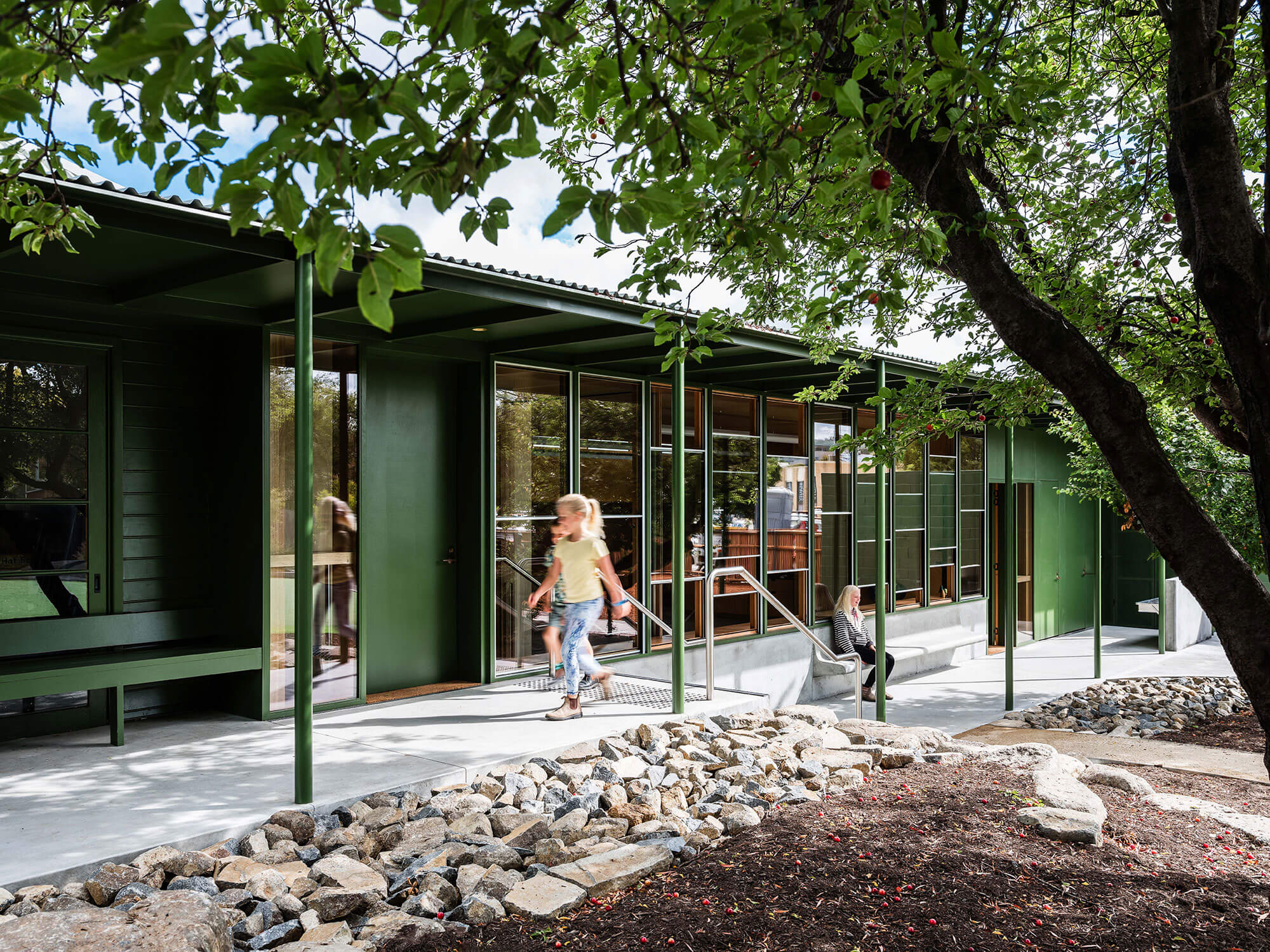
The Cottage School is a unique, small, independent, secular, community primary school. It is located in Queen Street, in Kangaroo Bay. The school prioritises the environment as a critical framework for learning.
Cohabiting a series of Federation weatherboard worker’s cottages, the School has established a unique pedagogical structure which borrows heavily from the intimacy and domesticity of its setting.
A new Green Cottage ‘addition’ was conceived as a unifying element between the existing external teaching and play environments, and the domestic scale of the original cottage. A verandah forms an extension of the educational realm, for woodwork, seating, and water play. Along this covered edge, an operable facade serves as a ‘streetscape’ for displays, and encourages imaginative play at thresholds. The sensorial environment is carefully orchestrated, through subtle acoustic and lighting. The new interiors are composed through a singular, warm and calming palette, which ‘backgrounds’ the experience of learning.
The Friends’ School Redevelopment Project | Bence Mulcahy with H2o Architects

The Friends’ School Major Redevelopment Project included, a gymnasium, adaption of the WN Oats Centre, site accessibility/safety improvements, a major substation, North Block repairs and new outdoor courts.
Approaches driving the project included the establishment of precincts within the campus, small strategic interventions to improve site accessibility and safety, utilisation/adaption of existing buildings, and Quaker values, simplicity, community and environmental stewardship.
Key projects are the WN Oats Centre refurbishment and the Revell Sports Centre.
The WN Oats Centre was adapted to accommodate x7 GLAs, specialist spaces, breakouts, offices, student/staff amenities in a light, robust, flexible and engaging environment.
The Revell Centre includes a gymnasium, offices, community/student amenities and x2 GLAs. Moderated by domestic scaled additions and street level detailing, its scale and siting draws from Carr Street precedents. Setbacks and landscaping tie the building into the campus, and materials strike the balance between utility and context.
Suite Shed | alsoCAN
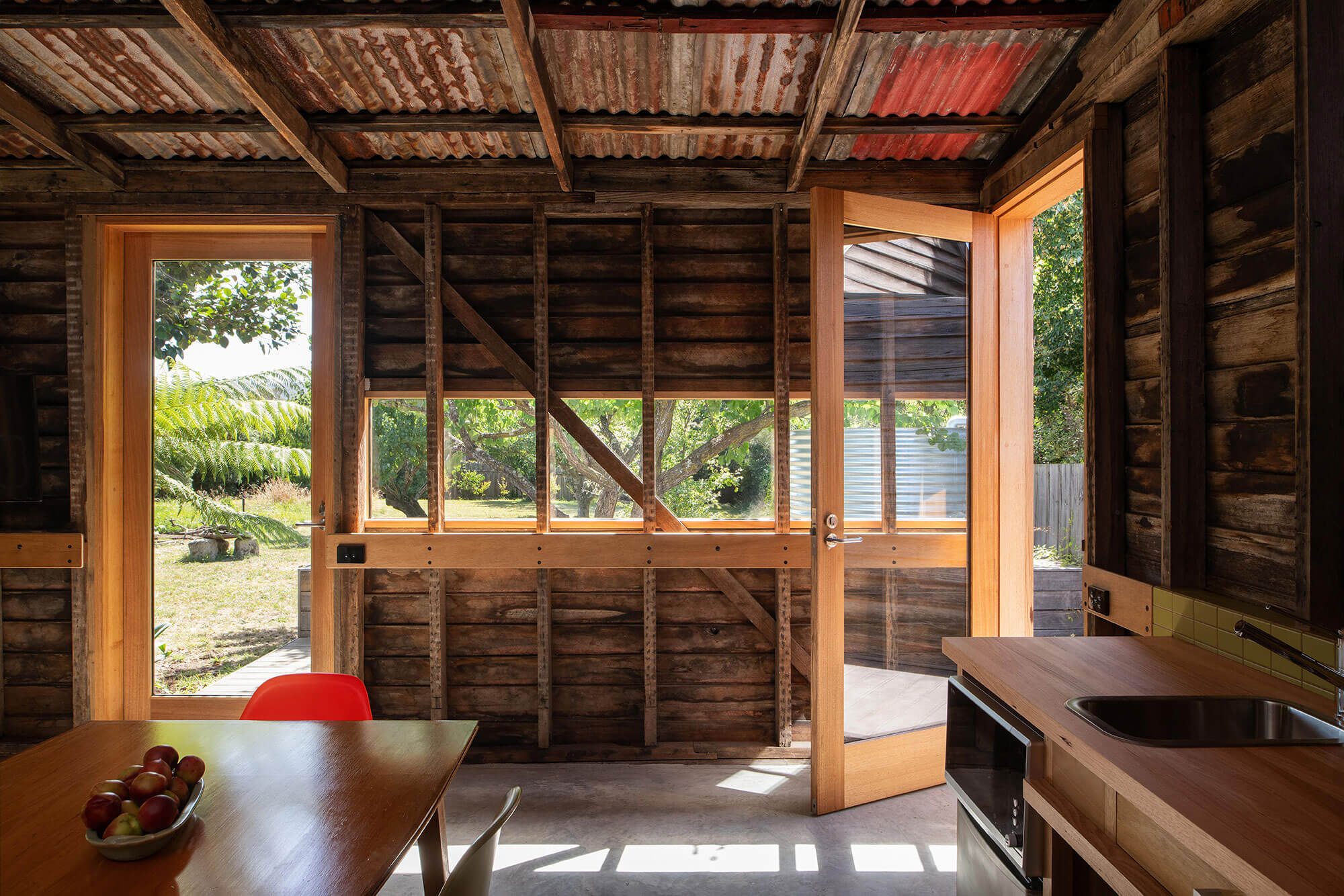
We retain traditional facades and streetscapes, but what about backyards?
The existing building had been a sleepout in a working backyard dotted with fruit trees. We wanted to keep this quality and this purpose.
From the outside, the result retains the same profile. Nearly all the existing structure has been kept, but now insulated and wrapped so its waterproof and warm. From the inside all the studwork, cladding and roofing remain, so it looks just like it did before with new fittings.
The new building adds no new floor area. However, we now have a larger bedroom, a refitted bathroom and a large space for living.
A critical part of the design was to make the building fully accessible. There are handrails around the outside of the rooms with sensoractivated lighting, along with more generally accessible aspects such as wheelchairaccessible benchtops, rails, a shower seat and talking kitchen appliances.