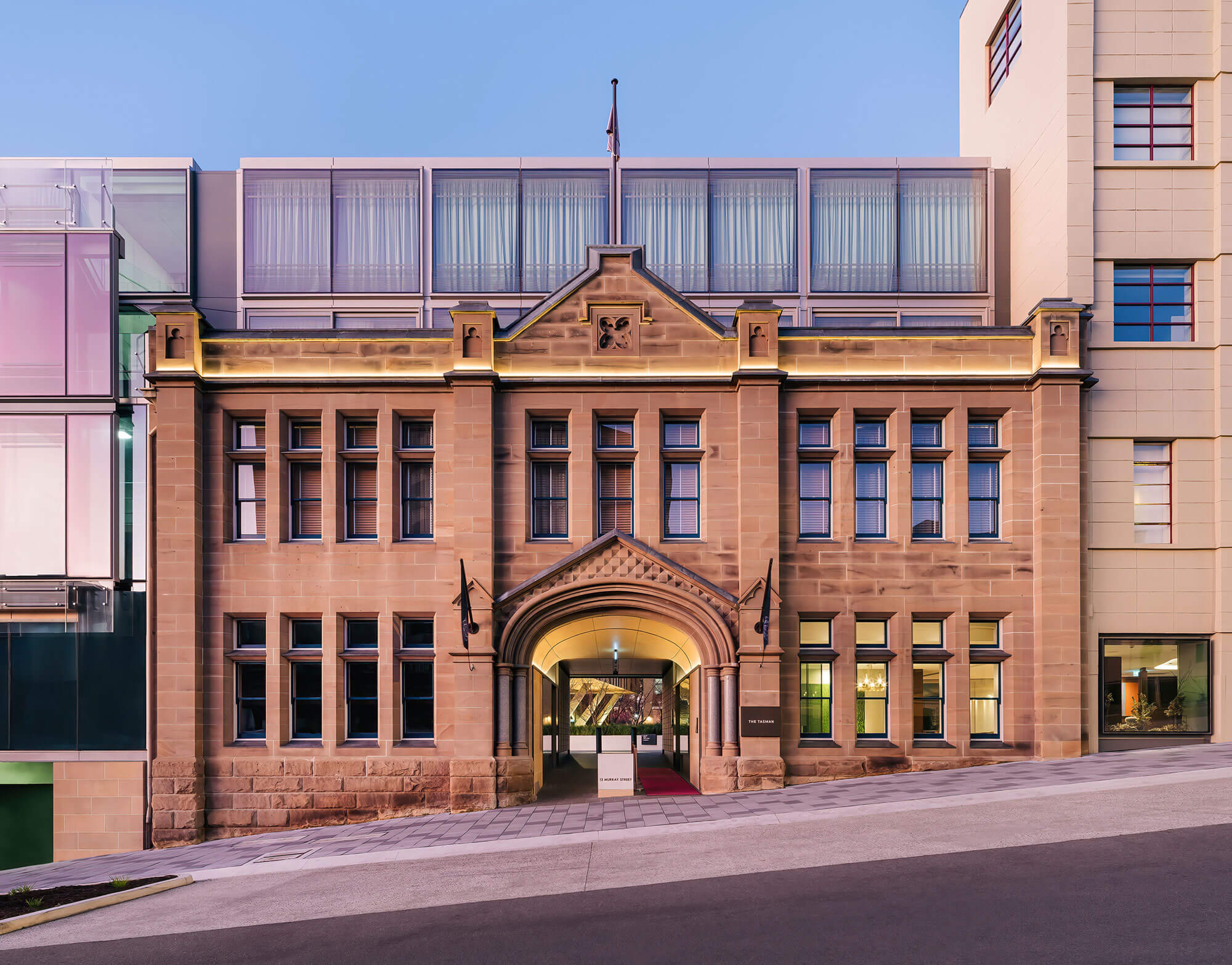
Regent Street Extension | Preston Lane
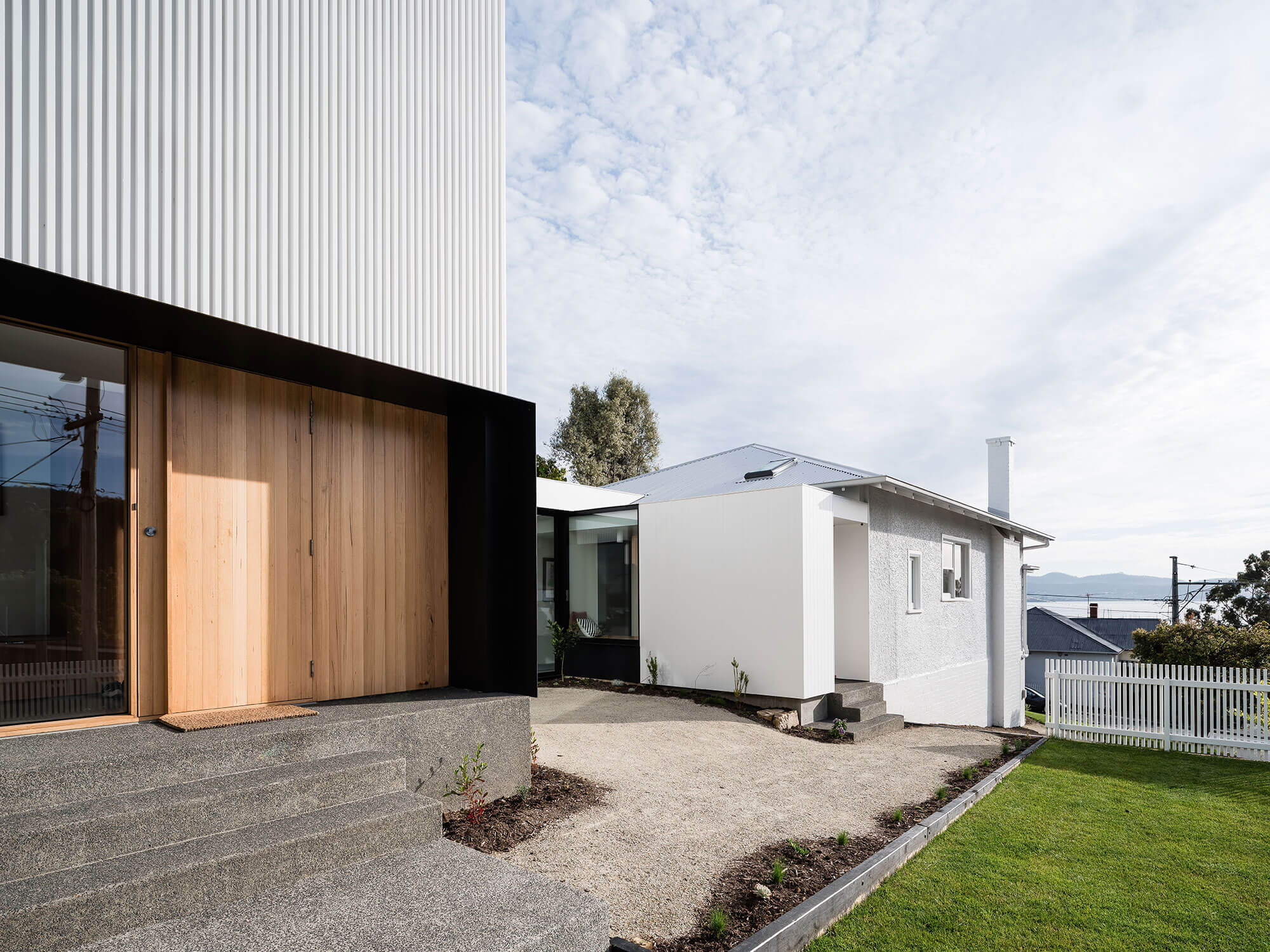
Located on the roundabout of a suburban arterial road in the heart of Sandy Bay, the extension steps up the slope of the corner site as it opens to the North enabling privacy for the occupants and distance from the noise of the road below.
Preston Lane was engaged to modernise the property to provide spaces for a growing family currently residing in Singapore. The extension included the revitalisation of the existing character home (back to its original form) and a substantial rear extension. An existing twolevel extension was removed as part of the works to reveal the original dwelling and to enable a better relationship between the internal and external spaces within the new works.
A new entry has been created off Alexander Street, providing greater connection to the homes new Living spaces housed within the new works, whilst a subtle side entry from Regent Street has been maintained.
Pedder Street House | Bence Mulcahy

This 1920s cottage renovation and extension better connects the interior with the northfacing rear garden for a couple and their young child.
The well-loved cottage with double-fronted facade of white stucco and asymmetrical gables has an informal and endearing character.
The brief, delivered in a new extension which continues the cottage’s hipped roof, includes master-bedroom, ensuite, kitchen, dining, living, powder-room and laundry.
Plan and section are tightly worked to yield a playful arrangement of internal spaces of varying floor and ceiling levels, aligned with terraced courtyard and garden, and a discrete second storey master-bedroom and ensuite.
Demolition of the rear of the cottage connects the original interior to the garden and maximises daylight.
The extension, on the north-eastern quadrant of the site, opens to the luscious garden and courtyard. The interior softy shaded by an overhead pergola and external trellised green wall.
Patrick Street | Andrew Campbell and Georgina Russell

The Patrick Street project involved a series of interventions in a c.1880 heritage listed terrace house in Hobart. The brief to contain the program within the existing envelope prompted a design approach of discrete ‘moves’ that sought to unlock the plan and provide broad functional amenity seemingly by doing as little as possible. These moves involved the reconciliation of routes and rooms, introducing new insertions designed as buildings in miniature, and functional double moves where a single design move responds to more than one functional requirement. Material selections were informed by the heritage response, with new and modified openings and thresholds constructed from steel serving as a contemporary language counterpoint to the existing masonry and timer fabric. The detailing of the new insertions was approached as an exercise in the use of plywood, standard timber sections and off-the-shelf mouldings as a method for developing a distinct language across the scheme.
Murdolo Apartments | ROSEVEAR STEPHENSON

In mid 2014, we were approached by the owner of 258 Macquarie Street, who nearly lost the property to fire shortly after it’s purchase leaving a dilapidated rental property uninhabitable and an owner with an enormous challenge.
Around the same time AirBnB was emerging and we suggested adapting the building specifically to this new typology to achieve the returns required to fund the restoration demands.
We developed a policy of removing the intrusive elements, repairing damaged external fabric where required and distinctly inserting new elements within the existing spaces and externally as clear modern attachments. Where existing fabric could remain in it’s current state, it was left that way, “even the fire history” such that a patina of eras is on display.
During the 258 construction, 260 was purchased by the owner allowing us to restore both terraces as a whole and reestablish their stately Georgian presence on Macquarie Street.
Lisa and Matt’s Place | Bek and Hame
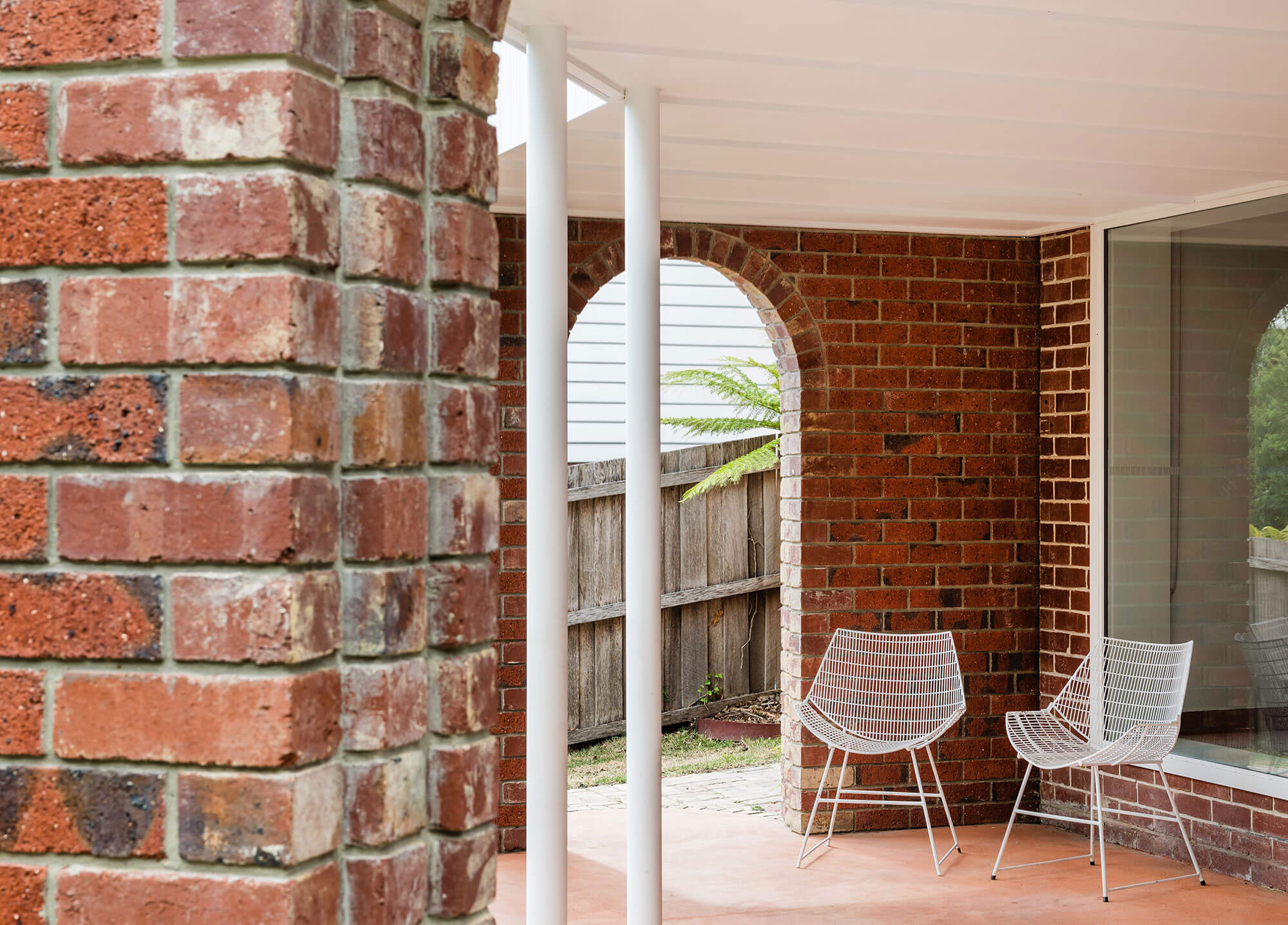
The project, a rear extension to a much loved quintessentially Hobartian red brick family home, facilitates greater outdoor connectivity and natural light to a previously closed garden façade. Though the employment of connected upper and lower storey space and eye directing planes, inviting views toward the garden whilst editing out the adjacent properties, the project ensures both upper and lower storeys meet the needs of the backyard devoted occupants. Small moves for big impact underpins the approach, including the conversion of an unused under croft space into a lightfilled family rumpus room, the addition of a garden accessing internal staircase to a north facing family dining space and kitchen, and the carefully crafted restoration of the existing front rooms of the home. By enacting the ideology of doing more with less, the project encapsulates the achievement of greater family liveability within a footprint reflective of a contextually sensitive scale.
Lexus of Tasmania and Omotenashi | BYA with Core Collective Architects

The Lexus of Tasmania showroom & Omotenashi restaurant is a unique space that marries the company’s Japanese heritage with its Tasmanian context. Designed by BYA Architects with Core Collective Architects, the interior is restrained and quiet; a beautifully crafted and distinctly Tasmanian backdrop for the showcased cars. The interior reflects the brand identity of both Lexus and Omotenashi whilst creating a unique customer experience that is understated and elegant.
James Street | Taylor and Hinds Architects

Conceived as a brick villa, James Street is located on an overshadowed and compact site, on the urban rim of Launceston’s colonial streetscapes.
The condition of the tight site, topography, and the presence of a century-old walnut tree is resolved in a strategy of walled courtyards, terraces, and volumes which abut the street edge.
From the street, walled courtyards elongate the entry sequence into the private realm. Quieter, immersive needs are oriented toward the light of walled courtyard gardens.
Elevated brick terraces allow for measured access to sunlight and aspect, and create daily connections to the streetscape. The walnut tree is used as a seasonal hinge for the composition of these courtyards and rooms, around which the interior volumes and gardens coalesce. This offers an unanticipated sense of expansion to the interiors, which is magnified by a subdued and dark palette that lofts towards the higher volumes.
Finlay Street | Christopher Clinton Architect

The Finlay Street project centres on a heritage-listed utility structure, once part of 34 Hampden Road. Alterations feature a new living area, removal of an unsympathetic fit-out, and landscaping with a north-facing green ‘warm’ roof. ‘Portals’ with integrated joinery enhance functionality and selectively frame views in existing west-facing openings. The northern addition maintains the original floor level, integrating a green roof intentionally kept low. A ‘lantern’ roof section, set apart as a distinctive glazed form independent of the main building, allows light penetration, ensures privacy, and establishes a visual link with the original house. Internal improvements expose and preserve the original brick structure, replacing laminate flooring with Tasmanian oak, and introducing detailed timber joinery. Achieving a harmonious blend of contemporary living, conservation, and historical sensitivity, this project reflects a successful collaboration among architect, client, and builder. The delicate balance between heritage preservation, functionality, sustainability, cost, and aesthetics defines its success.
Arch South | ROSEVEAR STEPHENSON

Arch South is the first example of a multidisciplinary response to sexual harm in Tasmania, a place where counselling and support services for sexual assault come together in the same location as specialist police services, making it possible for victim survivors to present to a single location and be empowered to make informed decisions.
The Arch project was an opportunity to assist the Department of Police, Fire and Emergency Management in the development of an emerging building typology. Consulting and counselling rooms were combined with functions commonly found in police stations, such as interview rooms, forensic and operational areas.
A warm, cosy fit out with natural light and planting was sought to make the centre more accessible. Colour psychology was employed to instil perceptions of healing and renewal. Natural timber accents are used to provide a link to the endemic natural environment.
Parliament Square | Design 5 – Architects, fjcstudio (formerly fjmtstudio), JPDC and Years Months Days