Support the Venice Architecture Biennale and Australian Architecture Exhibition
Architecture shapes the way we live, connect and respond to a changing world. From housing and climate to culture, technology and Country, the challenges ahead call for fresh ideas, shared perspectives and meaningful collaboration.
For more than two decades, the Australian Institute of Architects has brought Australian architecture to the Venice Biennale, sharing our ideas and creativity with a global audience. In 2027, Australia’s exhibition will continue this journey in Venice before returning home for a major Australian activation in 2028.
Whether through partnership, philanthropy or institutional support, there are many ways to be part of this story and help Australian architecture reach new audiences, build lasting connections and contribute to a better built future.
Become a Partner
Put your organisation alongside the ideas shaping what comes next.
Partnership is for organisations, architectural practices and academic institutions that want to actively support Australia’s presence in Venice and be connected to the people, ideas and conversations surrounding it. This is an opportunity to demonstrate what your organisation stands for and create meaningful connections with architects, researchers, academics, design leaders and decision-makers.
Help take Australian architecture to the world and bring its ideas home.
A philanthropic gift will help realise Australia’s national exhibition at the 2027 Venice Architecture Biennale and support its return home through the 2028 Australian activation.
Through the Australian Institute of Architects Foundation, your donation will give Australian ideas, research and architectural thinking a place in one of the world’s most significant architectural and cultural conversations.
Your support will contribute to a lasting cultural legacy and create opportunities for the architects, researchers and thinkers whose work will shape how Australians live in the future.
Donations of $2 or more may be tax deductible, and an official receipt will be provided.
The 20th International Architecture Exhibition is titled Do Architecture — For the Possibility of Coexistence Facing a Real Reality, curated by Wang Shu and Lu Wenyu of Amateur Architecture Studio. The theme positions architecture as a direct, physical practice grounded in materials, labour, landscape and lived experience.
The Biennale runs 8 May – 21 November 2027 (pre-opening 6–7 May), across the Giardini, the Arsenale and venues throughout Venice.
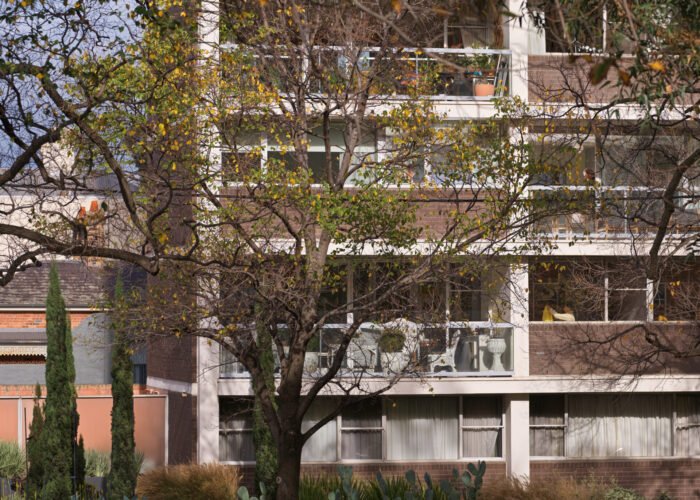
Domain Park Apartments, Robin Boyd, 1962, Melbourne, Australia, Bunurong Boon Wurrung and the Wurundjeri Woi-wurrung Country, photo Matthew Stanton
Australia Pavilion
Our National Pavilion
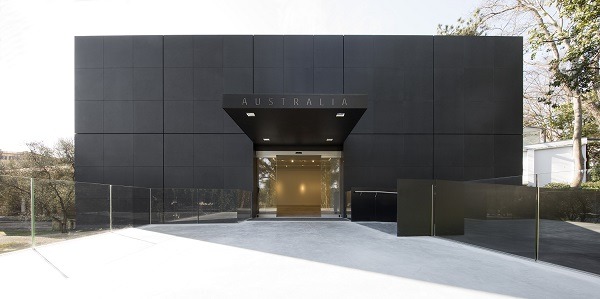
Australia is one of 29 countries with a permanent exhibition site within the Giardini della Biennale. In 2015, the Australia Council for the Arts unveiled Australia’s new permanent pavilion, designed by Denton Corker Marshall. This replaced a temporary exhibition space designed by Philip Cox in 1988, in use until 2013.
The Australian Institute of Architects has served as Commissioner for Australia’s exhibition at the Biennale since 2008.
Australia Pavilion | Denton Corker Marshall | Photographer: John Gollings
Past Exhibitions
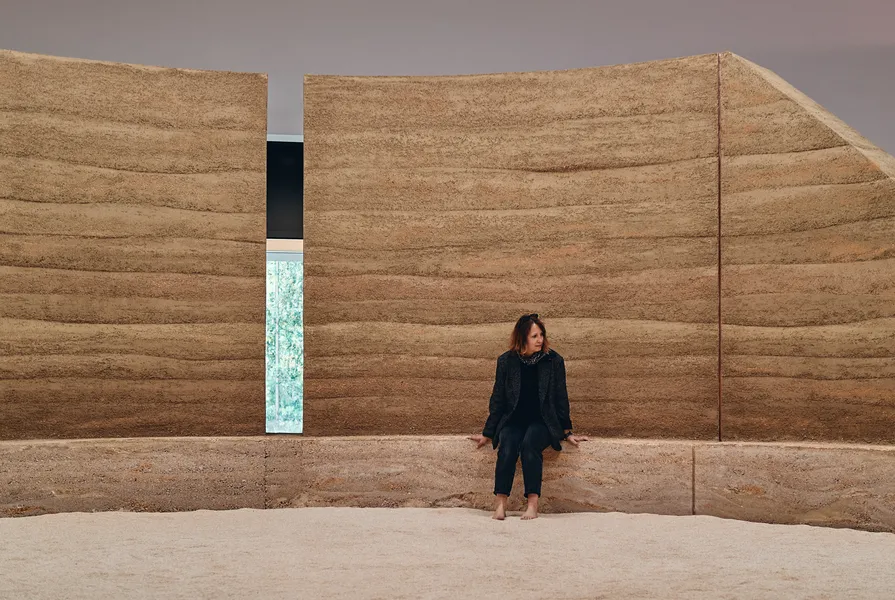
HOME | 2025 Venice Architecture Biennale | Photographer: Peter Bennetts
2025 - home
Dr Michael Mossman, Emily McDaniel and Jack Gillmer-Lilley
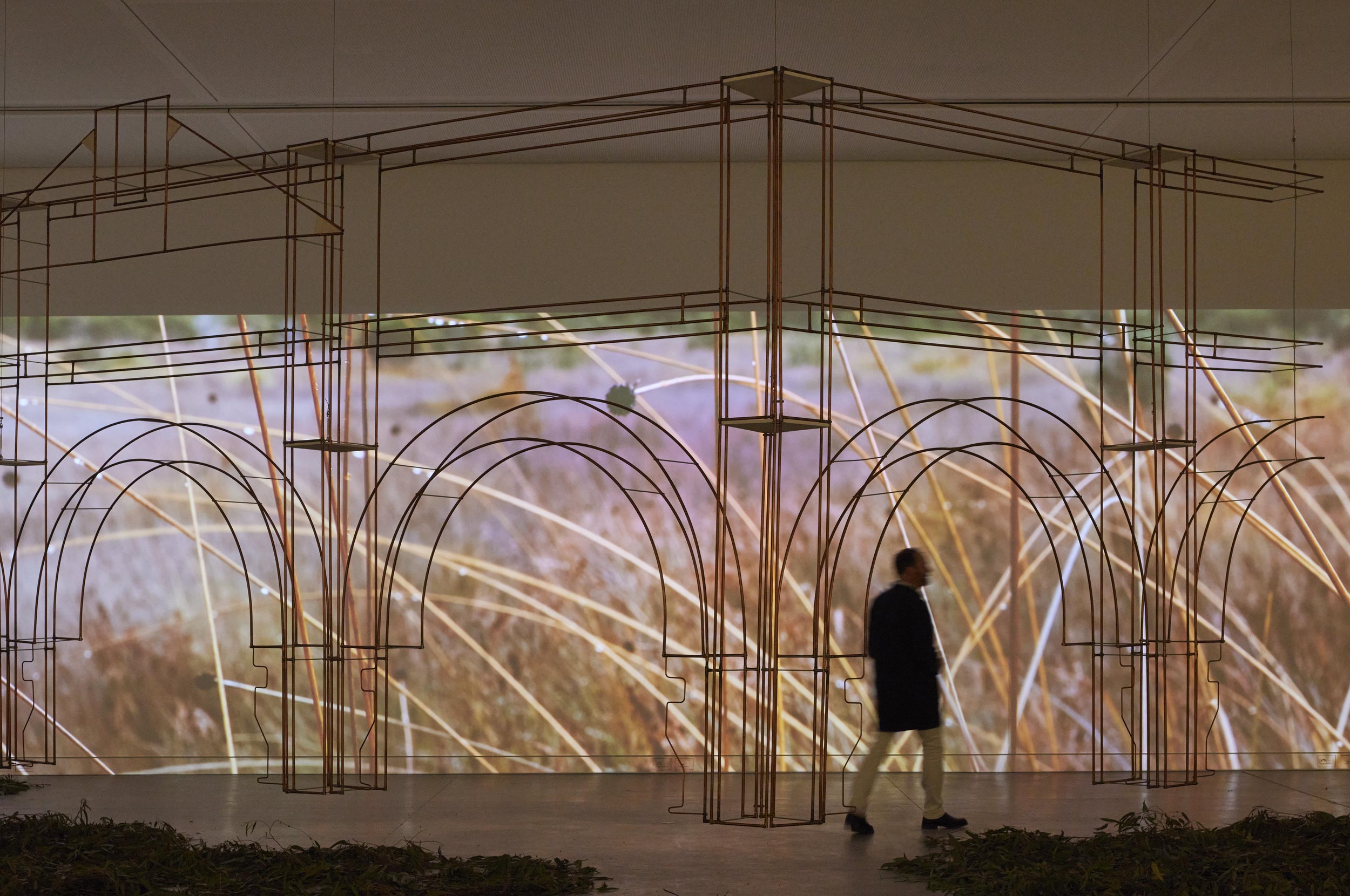
Home presented an immersive experience grounded in Indigenous knowledge systems, conceptualising home as a convergence of memory, sensation, relationships and future. Visitors engaged with the Country Sphere, an interactive space for sensory engagement with earth, sound and tactile elements, and were invited to contribute to the Living Canvas.
Unsettling Queenstown | Anthony Coupe LFRAIA, Julian Worrall RAIA, Emily Paech, Ali Gumillya Baker and Dr Sarah Rhodes | Photographer: Tom Roe
2023 - unsettling queenstown
Anthony Coupe LFRAIA, Julian Worrall RAIA, Emily Paech, Ali Gumillya Baker and Dr Sarah Rhodes
Australia’s identity is built on a double rupture: the expropriation of First Peoples’ lands; and the displacement of settler populations from their ancestral motherlands. The country’s wealth is based on an extractive relation to nature, regarding it as a standing reserve for exploitation. A dominion within the Commonwealth, Australia’s statehood is bound to the British Crown. This structure of relations to land, people, and nature are inscribed in the patterns of its settlements, its architecture the spatial language of this inscription.
Queenstown’ is the name we give to this pattern of relations. At the end of the second Elizabethan Age, as the voice of First Peoples calls for reckoning, and with planetary urgencies pressing, the settled configuration of this contested inheritance is under question. Queenstown is being unsettled. This exhibition explores and participates in this unsettling, weaving elements from real places and gleanings from current architectural intelligence in search of ingredients to contribute to Venice’s Laboratory of the Future.
Inbetween | Jefa Greenway and Tristan Wong | Photographer: SJB
2021 - INBETWEEN
Jefa Greenway and Tristan Wong
Inbetween premiered on Thursday 20 May, and will be exhibited this year throughout Australia, across the Pacific region and more broadly, as well as online. “Not being tied to the space in Venice has meant that we’ve been able to create something that can be experienced by a much larger audience. The great thing about the new format is that essentially anyone can access it and it has longevity beyond the dates of the Biennale.” explains Tristan. “This project isn’t a collection of artefacts; it’s forward looking and presents the innovative potential in learning from Indigenous methods and ideas. Embedding practices and knowledge that has been around for more than 60,000 years into the way we design buildings creates opportunities for a new kind of architecture that is better for people, cities and the environment.”
Repair | Baracco+Wright Architects with artist Linda Tegg | Photographer: Rory Gardiner
2018 - REPAIR
Mauro Baracco, Louise Wright with Linda Tegg
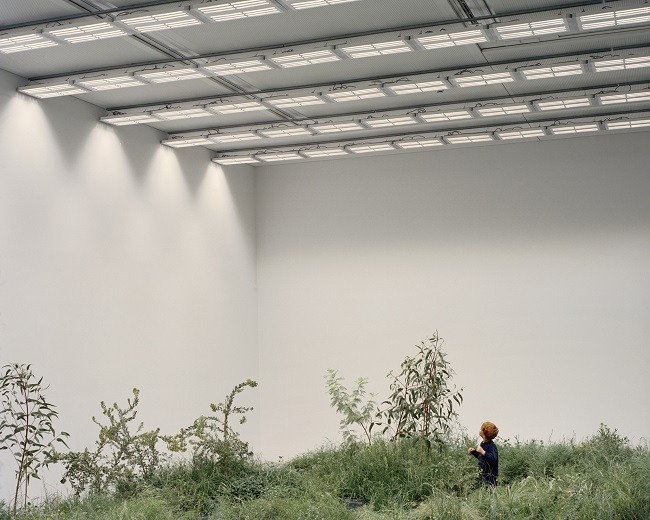
Repair focused on Australian architecture that integrates built and natural systems to effect repair of the environment, and in so doing, mend or improve other societal, economic, and cultural conditions.
On entering the Pavilion, visitors found over 10,000 native Australian grassland plants arranged inside and outside of the Pavilion’s granite structure. This field of vegetation, titled Grasslands, allowed visitors to enter a physical dialogue between architecture and the endangered plant community – with just one percent of these threatened species left in their native Australian environment.
2016 - Australia Pavilion - The Pool by Aileen Sage Architects (Amelia Holliday and Isabelle Toland) with Michelle Tabet. Photo Brett Boardman
2016 - The Pool
Amelia Holliday, Isabelle Toland (Aileen Sage) and Michelle Tabet
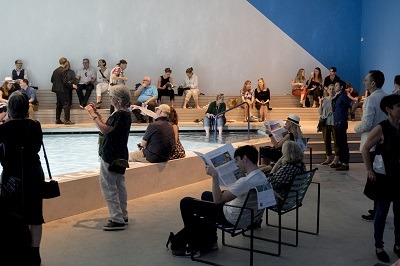
Using the pool as a lens through which to explore Australian cultural identity, the Australia Pavilion was transformed through the use of light, scent, sound, reflection and perspective to create a series of perceptual illusions within a designed landscape.
Eight prominent cultural leaders from various fields were selected to share their personal stories, using the device of the pool as a platform to explore the relationship between architecture and Australian cultural identity. These included Olympic gold medal winning swimmers Ian Thorpe and Shane Gould, environmentalist and 2007 Australian of the Year Tim Flannery, fashion designers Romance Was Born, writer of best-selling book The Slap Christos Tsiolkas, winner of the 2012 Miles Franklin Prize Anna Funder, Indigenous art curator Hetti Perkins and Australian rock-musician Paul Kelly.
The aim of the exhibition was to step outside the architect-to-architect discourse to show how a familiar, common object, the pool, is in fact pregnant with cultural significance, it is both artefact and catalyst of change. The Pool is about public space as a vital component to society and shows the many ways in which its public character is interpreted and occupied.
Augmented Australia 1914-2014 – Minifie van Schaik, Caught Unawares, 2013, Sydney. Digital reconstruction by Ben Juckes.
2014 - Augmented Australia: 1914 - 2014
felix._Giles_Anderson+Goad
Augmented Australia provided a virtual journey through 23 of Australia’s most intriguing unbuilt projects through the use of a dedicated app.
Augmented Australia’s virtual experience began under a temporary Cloud Space, where display images of each project automatically triggered three-dimensional (3D) augmented models, animations and interviews when viewed through the app. Including a 1:1 scale virtual model of the new Australia Pavilion by Denton Corker Marshall overlaid on its construction site.
The exhibition then extended beyond the Giardini with real-world scale augmented models of each unbuilt project geographically positioned in various locations around Venice, marking the largest exhibition of its kind ever seen.
2012 - Formations: New practices in Australian Architecture
Anthony Burke, Gerard Reinmuth, with TOKO concept design
Formations provided a cross-section of the state of Australian architecture and singled out thirty-three unique practice structures corresponding to its agenda. The project was essentially made up of two components: the exhibition, with the unassuming Australia pavilion as its nucleus, and an accompanying catalogue. Of the total thirty-three surveyed practices, the pavilion exhibited six.
The optimism and pluralist sensibility of Formations was laudable. Indeed, it may soon be the case that, as Ole Bouman says, “architecture has become a universal access code, a mother key that may open countless doors in culture and in society.” However, in the meantime, for any current student or young practitioner of a discipline and body of knowledge in turmoil, the need for professional (role) models is acute. The emancipatory bent of Formations is more timely than ever.
Now and When | John Gollings and Ivan Rijavec | Photographer: John Gollings
2010 - Now and When
John Gollings and Ivan Rijavec
Now and When explored the challenges facing our cities, engaging in timely issues that included sustainability, urban sprawl and density.
The ‘NOW’ component featured aerial views of Australian urban landscapes, including Melbourne, Sydney and Surfers Paradise, contrasted with giant mining pits at Kalgoorlie and Mt Newman by renowned architectural photographer John Gollings. The ‘WHEN’ component, overseen by Ivan Rijavec and produced by FloodSlicer, featured a sequence of ideas from 17 architectural collaborations of possible future urban spaces, including floating or submerged cities, or desert spaces.
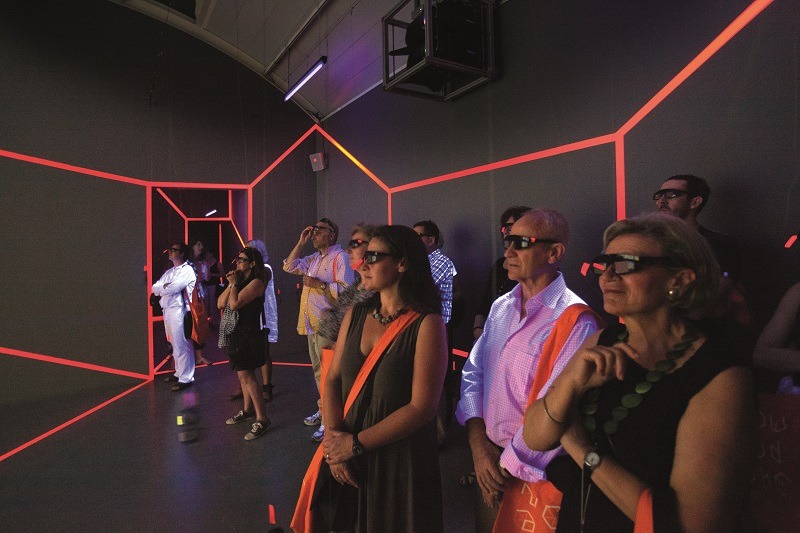
Now and When exhibited on a completely new form of 3D stereoscopic technology, which goes beyond the latest cinematic release. Visitors were able to move around these urban scenes and experience the urbanised worlds from different perspectives.
Abundant | Neil Durbach, Vince Frost, Wendy Lewin, Kerstin Thompson and Gary Warner | Photographer: John Gollings
2008 - Abundant
Neil Durbach, Vince Frost, Wendy Lewin, Kerstin Thompson and Gary Warner
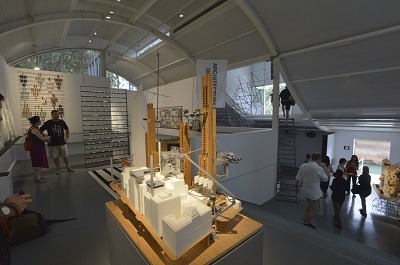
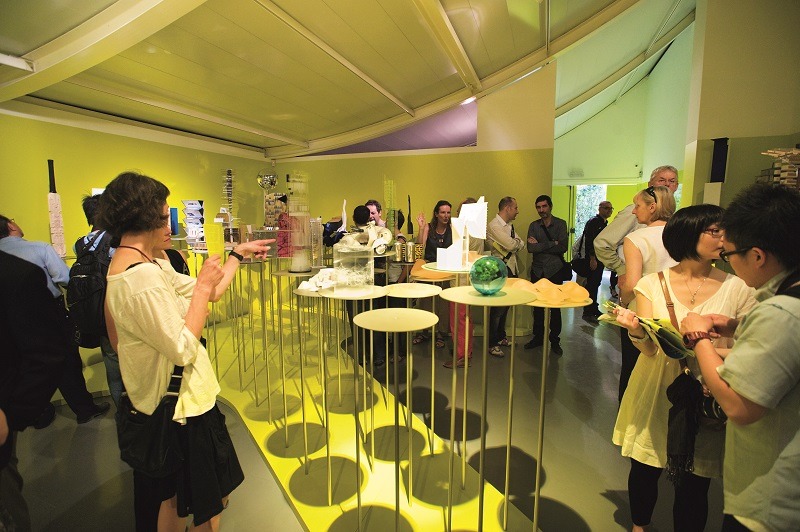
Abundant Australia explored the astonishing ability of Australian architects to blend new influences, dramatic landscapes and Australia’s unique multicultural society. Featuring over 140 architectural models of both domestic and commercial buildings from prominent Australian architects, including Ashton Raggatt McDougall, Denton Corker Marshall and Iredale Pedersen Hook, the exhibition revealed an architecture that is distinctly Australian.
Anita Belgiorno-Nettis AM Luca Belgiorno-Nettis AM
Venice Biennale Bronze Partner
Venice Biennale Event Sponsor
NETWORK VENICE
JOIN THE AUSTRALIAN INSTITUTE OF ARCHITECTS ON THE JOURNEY TO VENICE IN 2025
The Venice Architecture Biennale, the premier global platform for architectural innovation, presents partners with a unique opportunity to align with a prestigious international event that attracts a global audience of professionals, decision-makers, and design enthusiasts.
This exhibit comes at a critical moment in Australia’s history, following the Referendum No Vote on the Uluru Statement from the Heart. HOME serves as a timely and profound response, inviting a deeper understanding of First Nations perspectives and reinforcing the importance of truth-telling and cultural exchange.
To bring this vision to life, we are seeking your partnership. Sponsoring the Australia Pavilion will support the design team as they execute a dynamic public program in Venice and achieve their mission of sharing First Nations perspectives with the world. Moreover, your sponsorship will contribute to the Institute’s plans for a national display of the exhibition in 2026, ensuring its impact continues beyond Venice.
Network membership
Venice Biennale Partnership
Sponsoring the Australia Pavilion offers your organisation a unique opportunity to advance its Reconciliation Action Plan by supporting First Nations procurement and meaningful engagement. By partnering, you will play a pivotal role in amplifying the voices and expertise of a First Nations design team, showcasing Country-led ideas and practices on a global stage.
Venice Patron
$100,000
Secure top-tier brand presence with unparalleled promotional benefits, VIP access to exclusive events, and direct engagement with the creative leaders shaping the 2025 Venice Biennale.
Venice Patron Schedule of Benefits
Comprehensive brand exposure across all platforms, physical, digital, and electronic marketing and communications promoting and reporting on the 2025 Venice Architecture Biennale.
Acknowledgement as Venice Partner of the 2025 Venice Architecture Biennale with the Australian Institute of Architects throughout pre, during and post initiatives.
Inclusion in Institute generated social media campaigns for the 2025 Venice Architecture Biennale.
Brand exposure and recognition as Venice Partner in e-News generated by the Institute directly related to the 2025 Venice Architecture Biennale, and inclusion in Institute generated 2025 Venice Architecture Biennale social media content.
Opportunity to promote brand activation onsite at Vernissage (Pre-Opening) launch.
Ongoing recognition as Venice Partner in all Biennale-related marketing post the event.
Brand exposure and recognition as Venice Partner in the Australian post-event tour showcasing the 2025 Venice Architecture Biennale.
Six (6) x invitations to the exhibition preview event in Australia.
Twenty (20) x Vernissage (pre-opening) passes.
Twenty (20) x invitations to the official opening of the Australia Pavilion.
Four (4) x invitations to the VIP Ambassador’s Circle Dinner held during the Vernissage (pre-opening).
Twenty (20) x invitations to the Vernissage closing party (Commissioners Cocktail Dinner).
Access to the Creative Directors for a private event or showcase.
Elevate your brand with extensive exposure across digital and physical platforms, priority access to key events, and premium networking opportunities with architects and industry leaders.
Venice Partner Schedule of Benefits
Comprehensive brand exposure across all platforms, physical, digital, and electronic marketing and communications promoting and reporting on the 2025 Venice Architecture Biennale.
Acknowledgement as Venice Partner of the 2025 Venice Architecture Biennale with the Australian Institute of Architects throughout pre, during and post initiatives.
Inclusion in Institute generated social media campaigns for the 2025 Venice Architecture Biennale.
Institute to share access on Australian architects travelling to Venice to attend the
2025 Architecture Biennale.
Opportunity to promote your company through two (2) x pull up banner stands at the Vernissage (pre-opening) in Venice.
Ongoing recognition as Venice Partner in all Biennale-related marketing post event.
Brand exposure and recognition as Venice Patron in the Australian post-event tour showcasing the 2025 Venice Architecture Biennale.
Four (4) x invitations to the exhibition preview event in Australia.
Ten (10) x Vernissage (pre-opening) passes.
Ten (10) x tickets to the Vernissage (pre-opening) Commissioners Cocktail Party.
Ten (10) invitations to the official opening of the Australia Pavilion.
Gain valuable brand visibility and recognition across key platforms while enjoying exclusive invitations to preview events and networking opportunities at the Venice Biennale.
Network Venice Supporter Schedule of Benefits
Logo inclusion in Exhibition brochure.
Logo inclusion on the Venice Biennale webpage (hosted on architecture.com.au).
Recognition as Venice Network Partner on the supporter’s wall in the Australia Pavilion.
Recognition as Venice Network Partner on the supporters page in Architecture Australia.
Two (2) x invitations to the Exhibition Preview event in Australia.
Two (2) x Vernissage (pre-opening) passes.
Two (2) x tickets to the Vernissage (pre-opening) Commissioners Cocktail Party.
Two (2) x invitations to the official opening of the Australia Pavilion.
Your donation, big or small, will help cover key costs, including exhibition installation, creative team travel, cultural programming, and sustainability initiatives to bring the project to life.
Make a donation, and make a difference
Donations can be made with Deductible Gift Recipient (DGR) status.
Please note that some benefits, such as event tickets, may not be included with donations.
Every contribution directly supports showcasing First Nations-led innovation and design excellence.
Electronic Funds Transfer:
Account Name: Australian Institute of Architects Foundation Limited
BSB: 333-025
Account Number: 553 930 726
Reference: Venice <Full Name and Member Number>
Please email us at [email protected] once your transfer has been completed, this will allow us to provide you with a tax receipt.
This website uses cookies to improve your experience. We'll assume you're ok with this, but you can opt-out if you wish. Cookie settingsACCEPT
Privacy & Cookies Policy
Privacy Overview
This website uses cookies to improve your experience while you navigate through the website. Out of these cookies, the cookies that are categorized as necessary are stored on your browser as they are as essential for the working of basic functionalities of the website. We also use third-party cookies that help us analyze and understand how you use this website. These cookies will be stored in your browser only with your consent. You also have the option to opt-out of these cookies. But opting out of some of these cookies may have an effect on your browsing experience.
Necessary cookies are absolutely essential for the website to function properly. This category only includes cookies that ensures basic functionalities and security features of the website. These cookies do not store any personal information.