
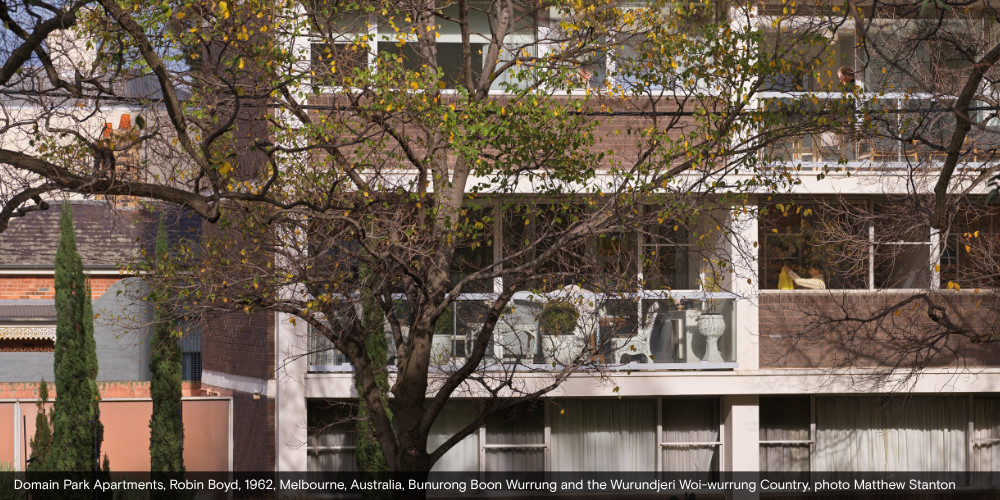
Lived In connects architecture and life.
As one of the world’s most urbanised populations – and contrary to Australia’s perceived suburban identity – many Australians live in apartments. Australia’s history of modern urbanisation has been relatively short but spirited, shaped by a rich body of inventive multi-dwelling architecture that has supported diverse ways of living.
The Australian Institute of Architects has announced Lived In as Australia’s exhibition at the 20th Venice Architecture Biennale, which will take place in Italy from 8 May to 21 November 2027. The Institute has proudly served as Commissioner for Australia’s exhibitions at the global event since 2008, and in 2028 will partner with the Museums of History NSW to see the presentation of Lived In exhibited in Australia. The exhibition is presented on behalf of the nation, and in partnership with Creative Australia.
Lived In will bring to life in Venice the built projects documented through the Housing Atlas of Australia project. This national teaching-led program was initiated by Monash University Adjunct Professor and RAIA Gold Medallist Kerstin Thompson of Kerstin Thompson Architects, developed collaboratively with Professor Maryam Gusheh, Associate Professor Lee-Anne Khor and Professor Louise Wright from the Monash Urban Lab in the Faculty of Art, Design and Architecture at Monash University. As a nationwide network for housing research and documentation, educators, practitioners and students have collaborated across multiple universities to capture more than a century of inventive multi-dwelling housing exemplars built across all states and territories of Australia.
The theme for the 2027 Venice Architecture Biennale, previously revealed by curators Wang Shu and Lu Wenyu, is Do Architecture – For the Possibility of Coexistence Facing a Real Reality, proposing a vision of architecture that incorporates the past as a living matter of the present. In response, Lived In will exhibit and capture the responses to context, climate and culture across both canonical and lesser-known works in Venice through drawings, data, photographs and film to show how housing shapes and is in turn shaped by everyday life.
The Venice Architecture Biennale states that Wang Shu and Lu Wenyu’s theme aims to “return architecture to its most concrete, physical and essential dimension: that of building in direct relation to the land, to the materials, to the communities, and to the reality of places. Their philosophy reaffirms the value of ‘doing’ as a cultural, ethical and constructive act, shunning spectacle and global standardisation”. Lived In claims and validates architectural knowledge and its impact on people’s lives. It looks backwards at expressions of living and forwards as Australia currently considers its housing supply and the environmental impact of its cities. It will also contribute to the international ongoing conversation around housing.
The Australian Institute of Architects began the 2027 campaign by inviting Australian schools of architecture to put forward future-focused research projects for consideration. Chris Brisbin, President of the Association of Architecture Schools of Australasia (AASA) said that “by working directly with Australia’s schools of architecture to select the 2027 project, the Institute is unlocking the Biennale’s capacity to engage practitioners, academics and students, and create long-term, sector-wide impact beyond the Venice exhibition”.
Twenty-one submissions, from across 11 institutions, were received. The Institute’s selection panel, comprising Adam Haddow, Senlina Mayer, Candice Halliday, Cameron Bruhn and Michelle Newton shortlisted four teams: How We Survive, University of New South Wales; Lived In, Monash University; Material Migrations, University of Melbourne; and Making Room, Monash University.
The Institute’s 2025-2026 National President Adam Haddow said, “Australia is facing urgent questions about housing, density, affordability, climate and the future of our cities. Architecture has a critical role to play in these conversations, not only through design, but through the lessons embedded in the housing we already have”.
Background:
Key details for Australia’s contribution to the 2027 Venice Architecture Biennale:
Commissioner: Australian Institute of Architects
Australian Institute of Architects jury: Adam Haddow, Senlina Mayer, Candice Halliday, Cameron Bruhn and Michelle Newton
Creative Directors: Kerstin Thompson of Kerstin Thompson Architects (KTA), Maryam Gusheh, Lee-Anne Khor and Louise Wright (Monash Urban Lab, Monash University)
Partners: Principal Partner, Brickworks; Curatorial Partner, Project Partner, Creative Australia; Alastair Swayn Foundation; Australian Presenting Partner, Museums of History NSW; Venice Partner, Planned Cover; and Media Partner, ArchitectureAU.com
Housing Atlas of Australia participating academic institutions, led by Monash University:
Bond University, Adelaide University, Monash University, RMIT University, University of Canberra, University of Queensland, University of Tasmania, University of Western Australia, UNSW, Western Sydney University. It is anticipated that additional academic institutions will contribute to the project in 2026/2027.
Bio statements:
Adjunct Professor Kerstin Thompson
Kerstin Thompson AM is Founding Principal and Design Director of Kerstin Thompson Architects. Committed to design-based research and education, she is also Adjunct Professor at RMIT and Monash Universities. In recognition of her teaching, industry leadership and internationally recognised design excellence, she was awarded the RAIA Gold Medal in 2023.
Professor Maryam Gusheh
Maryam Gusheh is a Professor in architecture at Monash University and co-director of the Monash Urban Lab. Her work examines the relationship between architectural practice and the social and political contexts in which the built fabric is designed, constructed, and received.
Associate Professor Lee-Anne Khor
Lee-Anne Khor is Associate Professor in architecture at Monash University, co-director of the Monash-AHURI Research Centre and a member of Monash Urban Lab. Her research focuses on the intersection of design, policy and cross-sector collaboration to drive the sustainable transformation of established suburbs.
Professor Louise Wright
Louise Wright is a Practice Professor of architecture and co-director of the Monash Urban Lab at Monash University. She is also a co-founder and director of the architectural practice Baracco+Wright Architects, based in Melbourne, Australia. Her research and practice focus on the intersection of architecture with the natural environment.
Monash Urban Lab
Monash Urban Lab is a research centre established in 2008 within Monash Art, Design & Architecture (MADA) at Monash University. The Lab focuses on the way cities are made, how they evolve, and how we can reset, repair and reimagine these relationships over time. Their research is anchored in real places and people: they work actively to explore how design research can improve the way we live.
Museums of History NSW
Museums of History NSW brings together a portfolio of historic houses, museums and the NSW State Archives to share the stories that shape NSW. Through its places, collections and programs, MHNSW connects people with the past and deepens understanding of history, identity and civic life. Its programs include Sydney Open, a year-round celebration of architecture and the built environment, giving audiences access to significant, innovative and rarely seen buildings and spaces.
Australian Institute of Architects
Australian Institute of Architects is the peak body for architecture in Australia, representing more than 14,000 members. The Institute supports architects at every stage of their careers and strengthens the quality, impact and integrity of the built environment. It advocates for the value of design in shaping better communities, supports professional standards and development, and provides leadership on issues influencing the future of the built environment. Through programs, events, research and partnerships, it connects the profession and elevates architectural practice nationally and internationally.