
Blackheath House and Studio | Design King Company

Set in the Historic village of Blackheath some 120 km’s west of Sydney and at an altitude of 1100 meters. The area was originally believed to be the summer corroboree meeting place for the peoples of the Darug, Gundungurra and Wiradjuri nations and lies amidst the World Heritage listed Blue Mountains Area. It is a unique cultural, natural and physical setting but at times a harsh one with exposure to extreme temperatures, wind, snow and bush fire.
The project consists of a free-standing studio and workplace for the clients, substantial alterations and additions to the existing house and finally the landscape and connecting infrastructure that ties the development together.
The whole ensemble retains the scale, form and spirit of the context of Blackheath while adding a layer of modernity and complexity to the way the site works and the buildings look, perform and operate as a home and workplace.
Blacktown Animal Rehoming Centre (BARC) | Sam Crawford Architects

The design of Blacktown Animal Rehoming Centre (BARC) balances the highly technical requirements of animal welfare with the need for a safe workplace and welcoming adoption centre.
BARC comprises a set of separate, elongated buildings; of fingers, reaching toward the woodlands of the Western Sydney Parklands. These fingers maximise cross ventilation and solar access, and prioritise proximity to nature, reducing stress and improving health of staff and animals.
Each building is drawn together and linked via a bold colour scheme and a 120m long, 4.5m high, multicolored artwork a collaboration with artist Lymesmith that evokes the plumage of native birds, and unifies, screens, and protects from the street the activity within.
As a council operated facility, BARC must accept all animals brought in by council rangers or citizens. Each is quarantined, given health checks, vaccinated, desexed, fed, washed; and then nursed back to physical and mental health ready for adoption.
Blacktown Exercise and Sports Technology Hub (BEST) | ARM Architecture with Architectus and CO.OP Studio

The Blacktown Exercise Sports and Technology Hub (BEST) is a world-class facility at the intersection of sport, culture, health and community. Designed by ARM Architecture with Architectus (landscape architects) and executive architect CO.OP Studio, BEST’s striking design is informed by the local multicultural vernacular, including Indian temples, Turkish bathhouses, and Chinese gardens. Its high-tech façade references sporting technology, including 3D printed equipment and apparel, carbon fibre prosthetics and aerodynamic fabrics.
The BEST serves as a centre for education, sports science and allied health, offering integrated facilities equipped with the latest in medical technology. Students, athletes and the broader community can access top tier treatment and rehabilitation services in a welcoming and inclusive environment. BEST is not for elite athletes alone; it has been conceived as a generous community asset aimed at improving long term health and wellbeing outcomes.
Blok Belongil | Blok Modular with Vokes and Peters
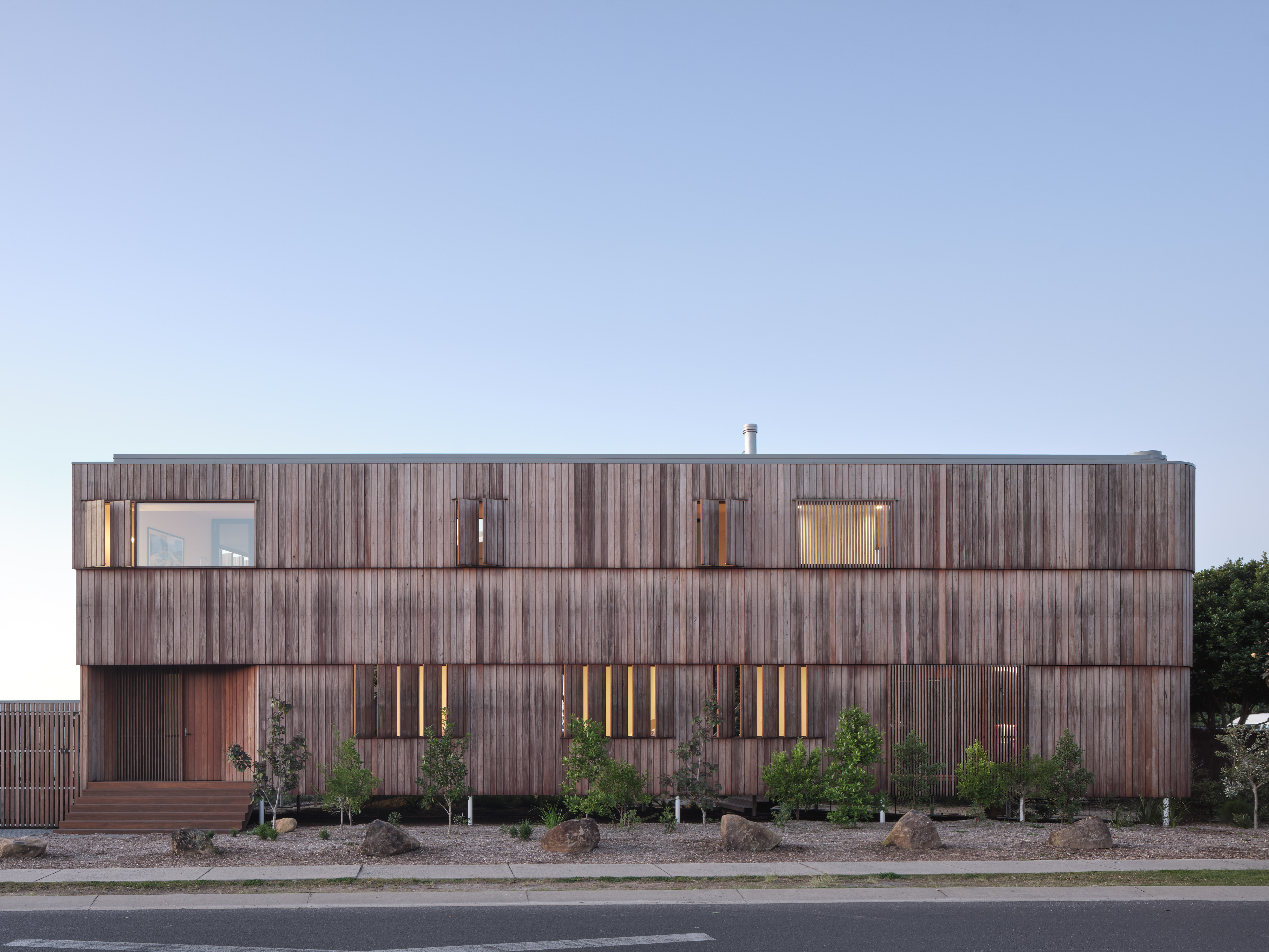
Blok Belongil is a new beach house produced in collaboration between Blok Modular and Vokes and Peters, exploring the adaptability and sustainability of volumetric modular building procurement.
Our client purchased a triangular shaped site, located between a public beach car park, a train line, and a busy neighbourhood feeder road, but blessed with panoramic views of the Pacific Ocean, the hinterland mountains, and Point Byron.
The house is conceived as a communal building (reception vestibule, lobby lounge, restaurant, private garden, guest suites etc) for our clients, their young adult children, and visitors to share time together. The house is small but spatially and experientially generous.
Modular procurement not only meets the local planning objectives (the house has to be removable in the event of rising sea levels) but building in a factory helps minimise the level of disruption (often toxic) to the local ecology of the building site and locale.
Blue & William | Woods Bagot

Blue & William reimagines the modern workplace in a post pandemic world.
Over 10 carefully considered levels, it’s a midscale commercial building set on the southwest edge of North Sydney’s CBD designed by Woods Bagot to celebrate location and maximise the stunning Sydney Harbour and city views.
Terracotta, kiln fired and glazed in a reddish ochre finish, frames each oversized 3.6m x 3.6m floor to ceiling window, while the building’s form is enhanced by a series of cascading terraces that magnify the panorama, open the building up and enabling staff to work outside if they want.
Inside, visitors are greeted by rich landscape and materiality drawn from the public spaces on Blue Street into the light filled lobby and wellness garden, bringing the outside in, enabling users to connect with nature.
Sustainability is central to the design with Blue & William achieving 5 Green Star Rating and a 5.5 NABERS Energy certification.
Blue Mountains House | Anthony Gill Architects
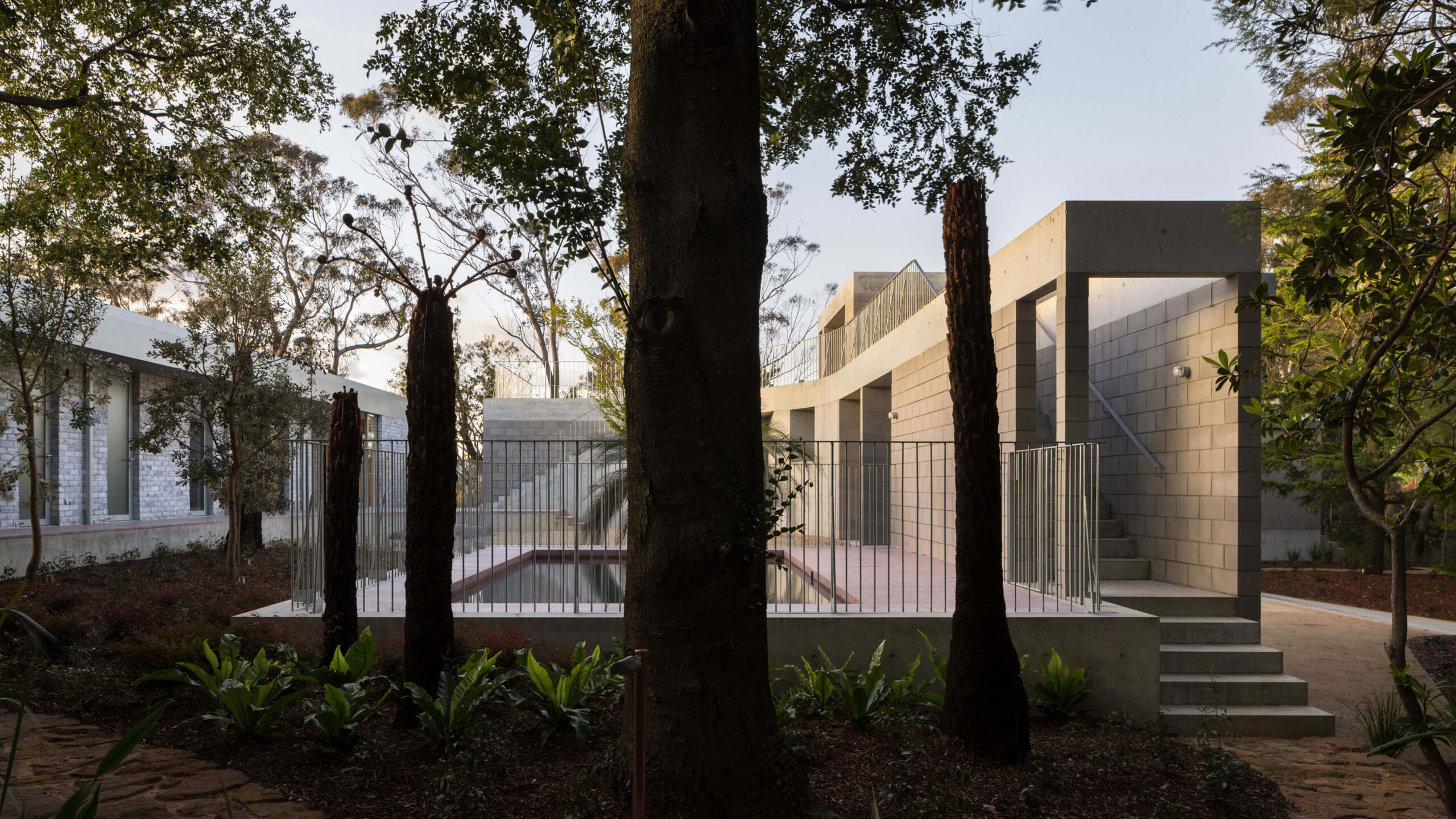
The project involved the substantial renovation of an existing 70’s kit home and the construction of a guest house adjacent.
The site is environmentally sensitive and classified as flame zone.
The existing house is modified to suit the client, becoming the family’s second home.
The guest house, excluded from the family’s regular use, is conceived as an extension of the site’s existing landscape. Acting as a large boulder or mass, it encourages the external traversing of the structure connecting its three separate external stairs with an original network of pathways on the site. This helps to absorb the building into the family’s realm.
This new structure enabled the site to be reorganised providing a buffer from the street and a new private, north facing entry courtyard that is the centre of the new home. It provides a place to gather, protected from the near constant southwesterly wind.
Bob Hawke College Stage 2 | Hassell
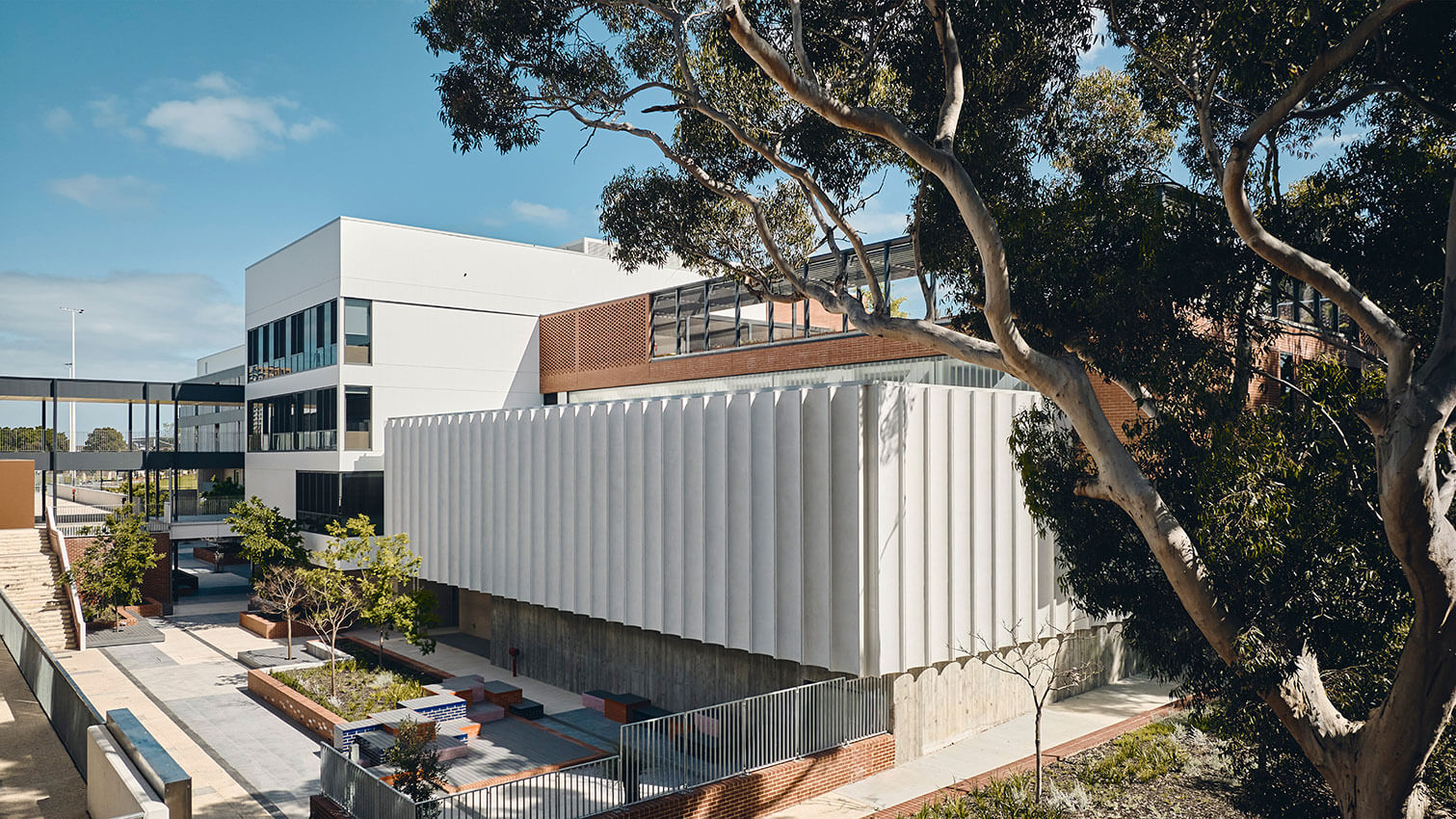
Stage Two of Bob Hawke College is a singular, four-storey campus building presenting a new northern façade facing onto community green space. A fluted, precast concrete Theatre is embedded into the heart of the building, anchoring the park facing corner of the site amongst mature heritage trees. The integration with existing parklands emphasises the sense of an urban multistorey school in a garden setting. An internally expressed ‘mega truss’ system above the Theatre supports a planted roof terrace breakout space for students looking onto community green space.
Co-located curriculum areas such as performance, visual art, media, music and general learning are directly linked with informal, independent learning breakout spaces. Visual arts ‘super studios’ have a north facing work terrace adjoining the community Greenlink.
Landscaped courtyards range across different locations and levels. The vertically dispersed landscape strategy links with surrounding community parklands and has resulted in significant net addition of precinct greenery.
Bobbin Head Amenities | Aileen Sage Architects

Two new public amenities buildings were commissioned by NSW National Parks and Wildlife Service at Bobbin Head.
Working with and expanding upon the language of a quintessential public building typology specific to NSW national parks, Aileen Sage collaborated closely with the client to achieve updated, modest yet highly functional, playful and sensitive facilities.
A pared back materials palette including galvanised steel structure, concrete with exposed local aggregate and perforated raw aluminum screens provides cost effective construction, robust amenity and easy upkeep.
A surprising lightness is achieved. The sloped roof, open structure and perforated screens draw in daylight and bright red accents are a playful nod to the historic picnic table structure roofs scattered throughout the area.
The forms sit highly recognisable against their densely vegetated backdrop, simultaneously providing contrast with and allowing the surrounding landscape to remain in the forefront.
Bob’s Bungalow | Blair Smith Architecture

This addition to a 1930 Californian bungalow in Strathmore, Melbourne, is a response to countless conversations with two romantics in semiretirement, accompanied by their rescue dogs, Archie, Buzz and at one time the projects namesake, the dearly departed Bob.
Project meetings typically involved sharing food, so this was conducive to extended, wide ranging discussions on subject other than architecture like; film, the veggie garden, collected artefacts, camping trips and the decades already lived within the house. These discussions and the idiosyncrasies of both individuals have now, somehow through osmosis, manifested into a space that evokes their personalities. As a space that compliments an authentically full life and decades of collected treasures, Bobs Bungalow is unashamedly pastichelike
a physical translation of an ongoing collaboration and friendship.
Bond Store and Watergate Wall – TMAG | Purcell Architecture
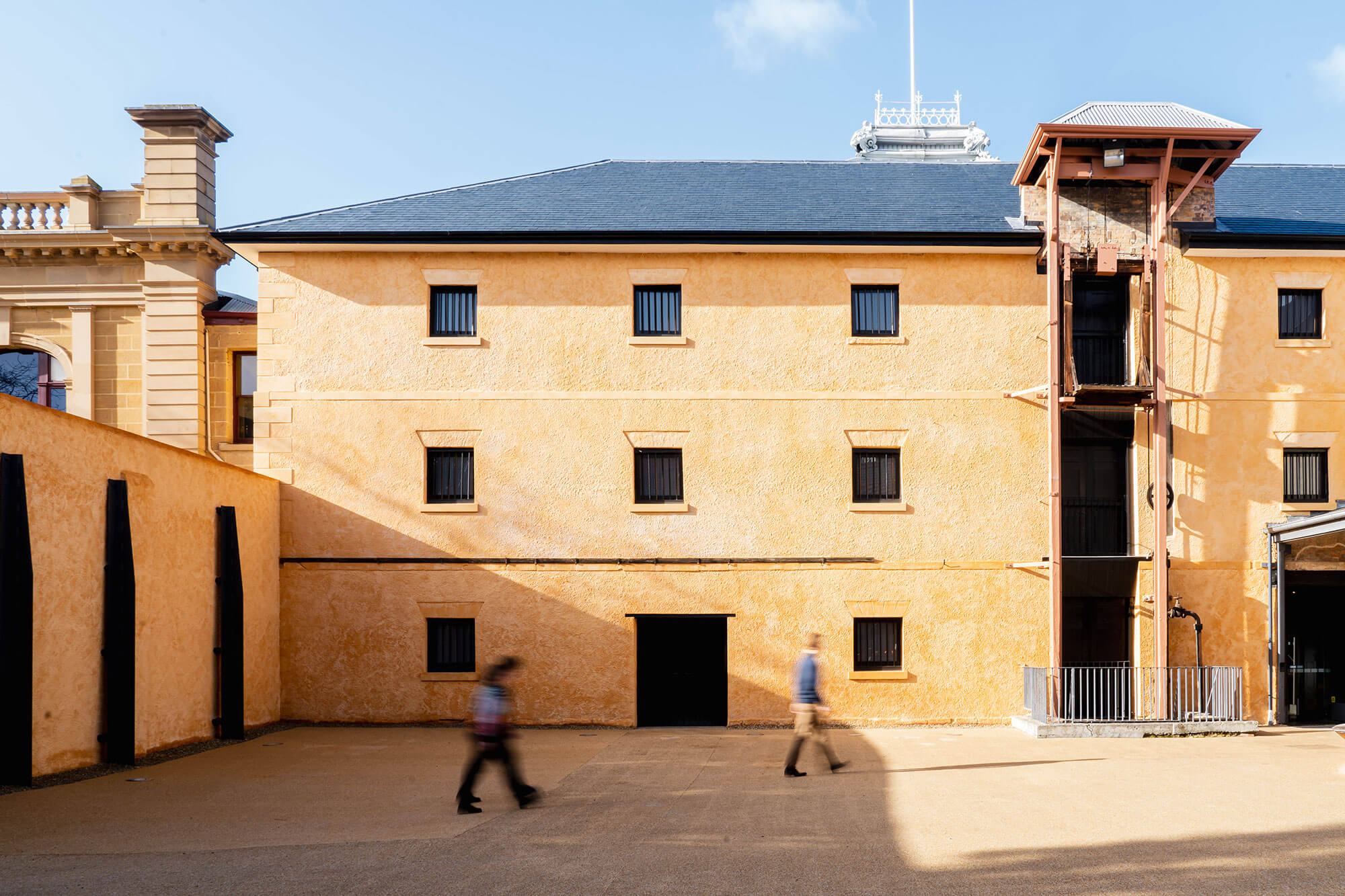
The Tasmanian Museum and Art Gallery (TMAG) comprises a collection of contemporary and historic structures, including the rare and intact Bond Store, and adjacent Watergate Wall. The conservation of these 200-year-old buildings was essential due to recent weather damage and ongoing deterioration.
Purcell, known for their expertise in retrofit, creative reuse, repair, and conservation, were engaged as the Heritage Architect to re-render and re-roof the Bond Store to its original state and stabilise and rerender the Watergate Wall at the sites entrance. Following extensive archival research and fabric analysis, Purcell and the wider team identified the structural and fabric matters compromising the integrity of the significant features. Rectifying these issues and using traditional materials and techniques returns both environmental and social benefit for the community.
This project revitalized a crucial historical site, strengthening the bond between Tasmania’s heritage and its community, while enriching educational opportunities and enhancing the visitor experience.