
Inkerman + Nelson | MA+Co

Inkerman and Nelson is a project that eschews austerity, taking instead a softer approach to articulate the legacy of the site. Previously industrial sites are replaced with brick terraces, comprising 26 two and three storey townhouses arranged around central courts and walkways. The townhouses are three and four bedroom dwellings with ground level living and flexible space on the second floor. The incorporation of a freestanding frame narrates the experience at ground level. Primary and strategic secondary points of access introduced throughout the ground plane create a circulation path that feels urban and connected, but also intimate. The detailing, materiality and layering of the existing building is embraced, resulting in a contemporary collection of amenable townhouses. In turn, Inkerman and Nelson is a precinct that decisively responds to its context and the demands of contemporary living through subtle gestures, laying the foundations for a community, that over time, will flourish.
International Grammar School: Renaissance Centre | BVN

The Project was envisaged to be the anchor project for this part of the campus, operating a city block away from its main buildings.
The public domain functions as the school corridors, shared with the Ultimo community as the learning within the classrooms adds to the activation of the streetscape.
The outcome of several consultation workshops saw three key elements would be the driving aspirations for the project to succeed.
It was designed to be a forum for exchange of ideas, a place where thinkers can gather in the round and share their work with the school, and vice versa.
Working on making flexible and inspiring spaces with an existing structural grid and a low ceiling, whilst aiming for an exceptional acoustic performance were the biggest challenges.
Each space aims to quickly adapt to the needs of the users, implementing different tools to open up or divide areas into more intimate spaces.
Ioppolo | vittinoAshe
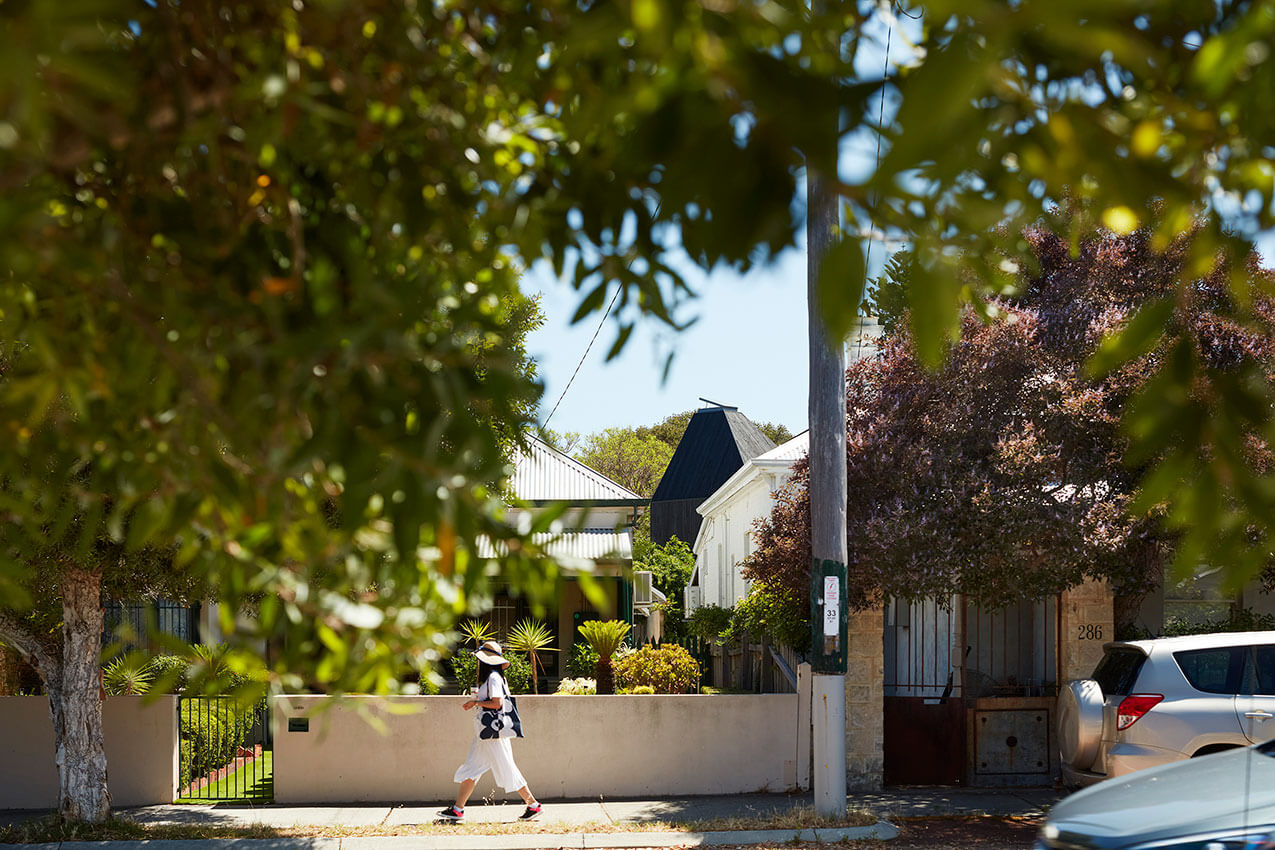
This project questions where the boundaries lie within the field of small residential models close to the city. The architectural proposition considers the Australian housing crisis and seeks to demonstrate a site-responsive, socially integrated alternative as a sustainable way to accommodate a sector of our population in detached dwellings.
This proposal explores a layered approach that, in addition to meeting client requirements, seeks to privilege ecological and cultural repair for the collective within the setting of a private residential lot. The design parameters aim to maximise the amount of permeable ground by stacking the program vertically and hence minimising the building’s footprint. This thinking has its origins in modernism, but the rationale and execution of it have been extended to include local neighbourhood accounts, ensuring we are not only maximising garden area and recharging the aquifer but also weaving social narratives and truth-telling in a non-civic, domestic setting.
Irrawaddy | Incidental Architecture
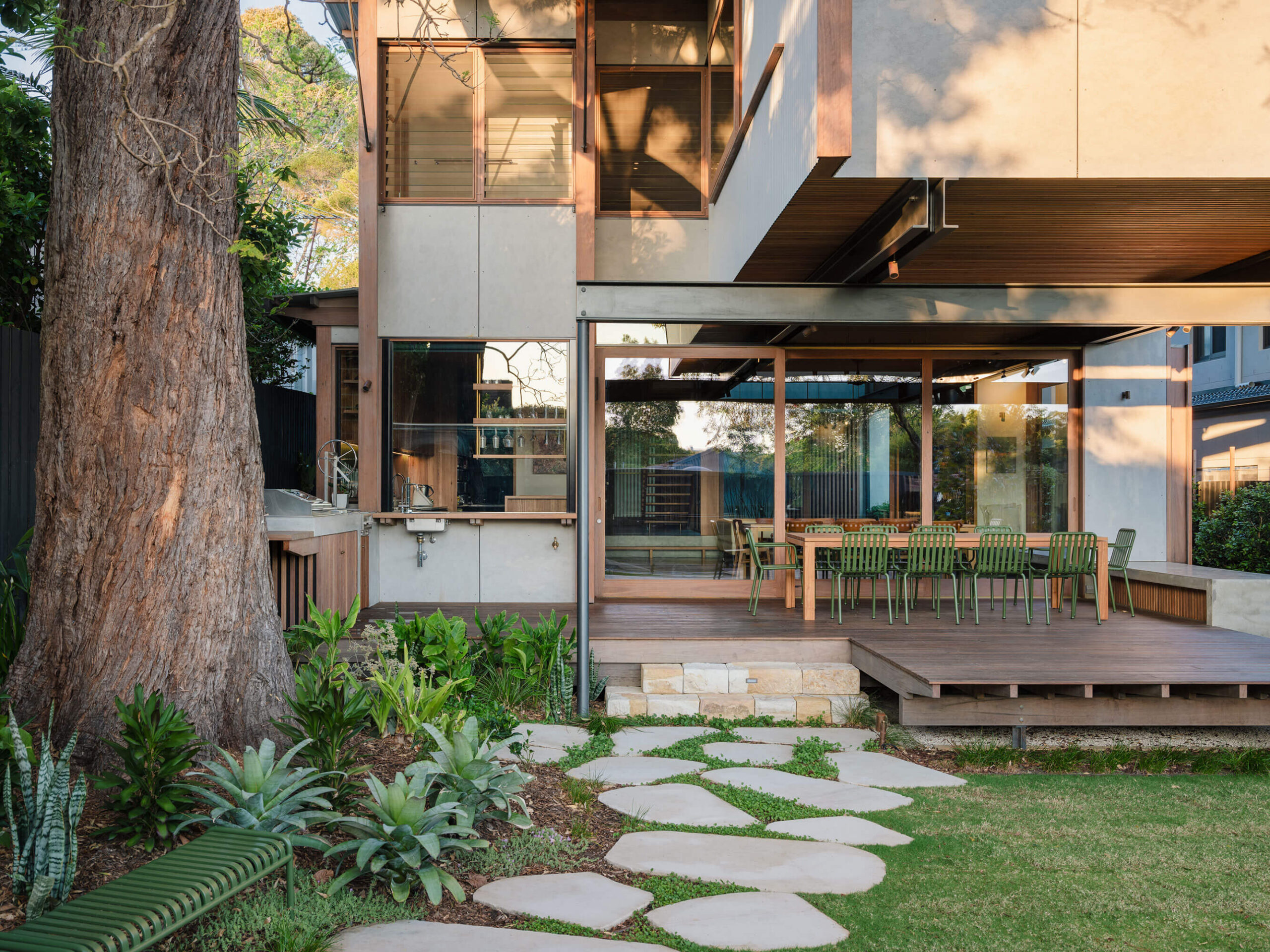
Irrawaddy is on Cammeraygal land, within suburban Chatswood. Although a larger house (271m2), Irrawaddy incorporates the fine grain to nurture a family of eight.
The clients, having grown up in what was Burma, shared stories of the Irrawaddy river being synonymous with the lifeblood of Burmese culture and fundamental to every aspect commerce, transport, spirituality, and not least, shelter.
Taking inspiration from the vernacular of Burmese delta houses on stilts, the branch like steel structure of Irrawaddy is expressed inside and out, straddling the ground floor footprint. Living spaces spill outside as the first floor floats overhead.
Motivated by their six children, playful elements are scattered throughout. A loft space is accessed by a rolling ladder through high level joinery. Monkey bars span between pavilions. Pivoting screens steal views between levels.
Kids bedrooms are deliberately tiny, only 2.3mx1.9m, with built in joinery allowing maximum function.
A house to gather yet retreat, work yet play.
James Makin Gallery | Tristan Wong Architecture & Design
James Makin Gallery is designed as a contemporary gallery space, but with the addition of small but impactful ancillary spaces. It seeks to deformalize the often institutional gallery typified by white only, squareset walls and in Makins words reframe the viewing of art. At the heart of this design counterpoint is a series of blackened, and curving, timber objects, walls and cutaways.
Visitors are drawn in and through a bellylike space: dramatic, textural and tactile. Only glimpses of the art beyond are given as one journeys through the social and ceremonial spaces of reception, bar, viewing room and library, before arriving at the main space.
The gallery celebrates its old factory roots and talks to notions of regeneration, whilst at the same time providing a specialised and functionally fit space for the viewing of art.
James Street | Taylor and Hinds Architects

Conceived as a brick villa, James Street is located on an overshadowed and compact site, on the urban rim of Launceston’s colonial streetscapes.
The condition of the tight site, topography, and the presence of a century-old walnut tree is resolved in a strategy of walled courtyards, terraces, and volumes which abut the street edge.
From the street, walled courtyards elongate the entry sequence into the private realm. Quieter, immersive needs are oriented toward the light of walled courtyard gardens.
Elevated brick terraces allow for measured access to sunlight and aspect, and create daily connections to the streetscape. The walnut tree is used as a seasonal hinge for the composition of these courtyards and rooms, around which the interior volumes and gardens coalesce. This offers an unanticipated sense of expansion to the interiors, which is magnified by a subdued and dark palette that lofts towards the higher volumes.
JamFactory Tarnanthi: Ernabella Arts Exhibition | Grieve Gillett Architects
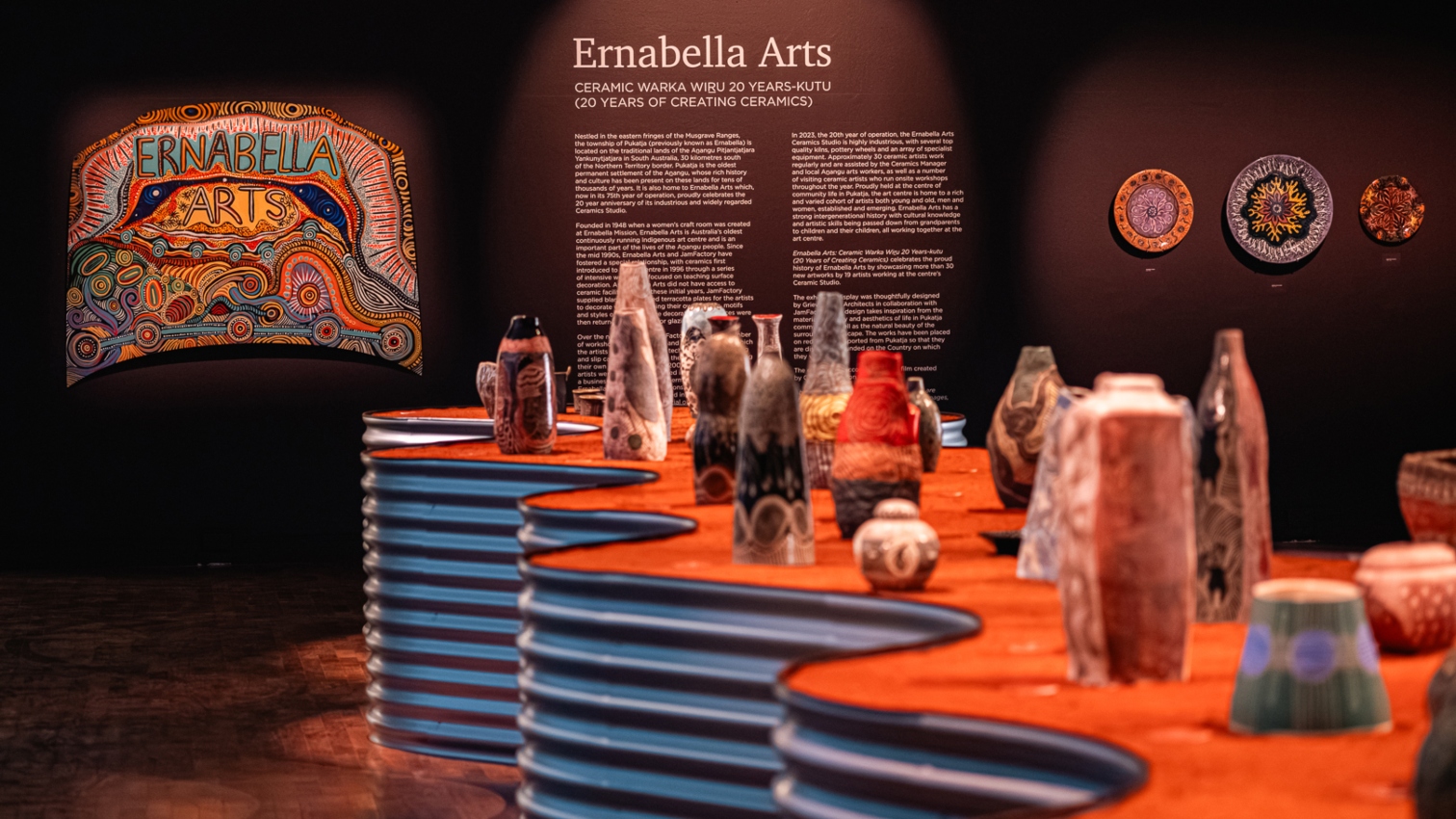
In celebration of 20 years of ceramics at Ernabella Arts, GGA co-created with JamFactory and the artists an exhibition of significant artworks, drawing on the relationship between the artwork, community and landscape. Qualities and characteristics of both the built and natural environment are brought to the gallery space, where the artists feel as though a piece of their home has been brought to the gallery, and that visitors have a sense of being transported to Pukatja. Central to the exhibition space is the corrugated iron display plinth, its sweeping curves referencing the aerial view of the landscape. Set against a backdrop of the dramatic landscape, the ceramic pieces rest on a bed of ochre-coloured dirt, brought in from Pukatja. Resourceful, like the artists themselves, the low-impact exhibition made use of reusable and recyclable materials that are rooted in a sense of place.
JD House | Architects Ink
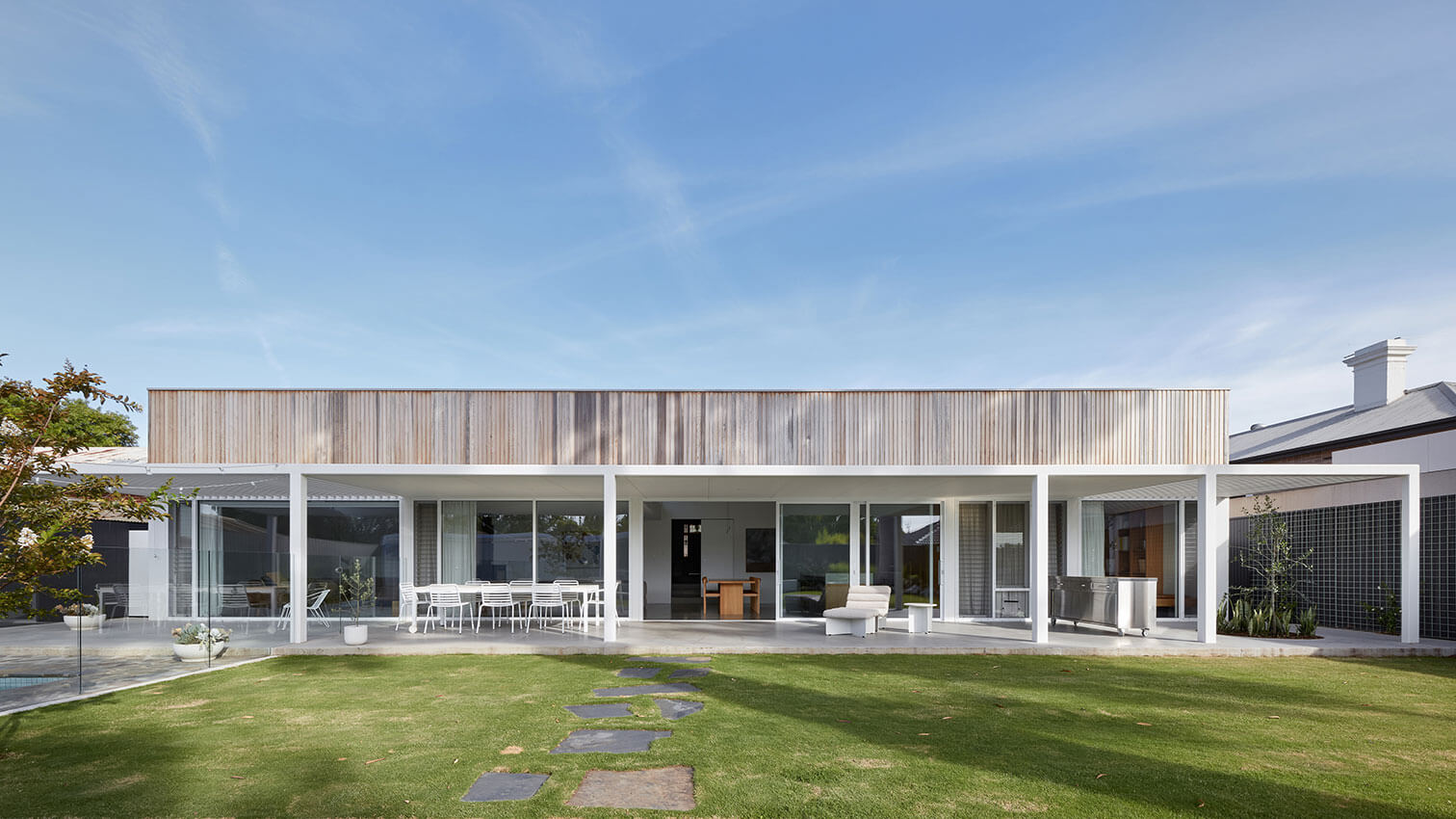
Humble in both scale and material JD House is a familial sanctuary, enhancing the lives of a family of five.
The original 1890s villa was preserved and a collection of structures, including a new addition, carport and garage were respectfully inserted between existing site elements.
Governed by a pursuit of lightness, each structure is supported by a delicate skeletal frame. The detailing is executed within the confines of 150mm framing sections, innovatively addressing drainage complexities.
Running almost the full width of the site and segmented along its length, the planning of the addition is uncomplicated and efficient. The interplay of varied ceiling heights and column spacing endows each section its own identity. Neatly wrapped in western red cedar, the external elevation conceals the undulation in internal volumes.
Composed of modest materials in light tones, there is a feeling of tranquility throughout, while the manipulation of light creates a dynamic environment.
Je ne sais quoi Villas | EMKC3

This new boutique resort in Seminyak, Bali features six teardrop-shaped villas with crescent-shaped roofs in an intelligent approach to a small site. Je Ne Sais Quoi or JNSQ gives guests the option to be social in a communal area or retreat entirely to their own private sanctuary.
Each of the six villas has its own minimalistdesigned private interior, with a centrallyplaced bed, multifunctional bedhead/desk, lounge area, mini bar and bathroom, looking out onto its own plunge pool. Even though each room is only 45 square metres, the open plan design and multifunctional furniture make it look larger.
The interior design at Je Ne Sais Quoi deliberately goes against the traditional Bali look to provide a more minimal and contemporary palette. Venetian plaster was used on all internal walls to create a soft, textured and neutral tone complemented by furnishings in shades of black and grey to reduce visual impact.
John Forrest Secondary College | TRCB
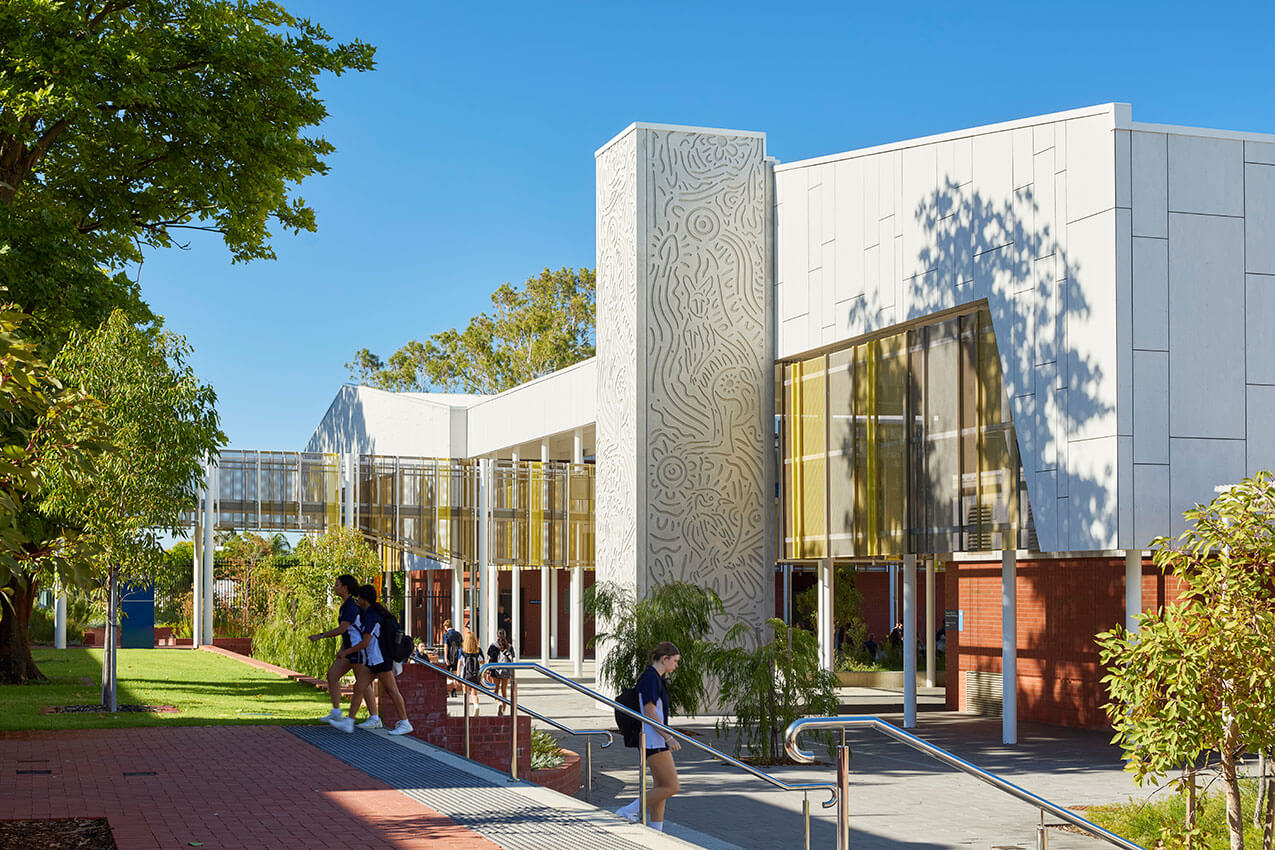
TRCB was commissioned as lead consultant by the Department of Education for the $50 million major rebuild of John Forrest Secondary College (JFSC).
The project, part of a state-wide initiative to upgrade secondary schools, modernised and expanded JFSC’s facilities while preserving its iconic character. Retaining mature trees and courtyard spaces was central to the endeavour, seamlessly blending new structures with the existing landscape. The redevelopment includes a new performing arts centre, cafeteria, gymnasium, and specialist teaching buildings.
Refurbishment and adaptive reuse of existing structures revitalised general teaching rooms, the library, and administrative spaces. Staged completion between 2022 and 2023 culminated in newly established facilities that seamlessly integrated with the campus’s layout.
Notably, the project incorporated three major artworks celebrating local indigenous culture, enhancing the educational experience for the College community. TRCB’s innovative design approach maximised refurbishment, ensuring JFSC’s continued legacy while meeting modern educational needs.