
Good architecture begins with understanding. Across the 2026 Awards, projects show how listening to clients, communities, users and cultural knowledge can shape places that are more connected to the people they serve.
Architecture is sometimes presented as the expression of a single design idea. In practice, the process is often much more collaborative. It can involve listening carefully, understanding different perspectives and translating lived experience, operational needs, cultural knowledge and personal aspirations into a built response.
At Gindaja Training Facility and Accommodation at Yarrabah by People Oriented Design, extensive co-design with Gindaja’s board, staff, community members and local artists shaped a culturally safe model of care grounded in Country, lived experience and local knowledge. Cultural identity is embedded throughout the project, including artwork developed with Yarrabah Arts Centre and references to Gindaja, the male cassowary and protector on Gunggandji Country.
Hymba Yumba Independent School Performance Hall and Arts Building by Deicke Richards reflects another form of listening, shaped through cultural understanding, educational needs and a long-standing relationship with the school community. The project creates a new cultural and creative heart for the campus, with learning and gathering spaces connected to Country and integrated First Nations artworks throughout.
At Quandamooka Arts and Cultural Centre (QUAMPI) by COX Architecture on Minjerribah, co-design with Quandamooka Elders helped embed the voices of the Nunukul, Goenpul and Ngugui Peoples into the project. Community involvement extended beyond consultation, with local participation in construction and the expression of culture through materials, interpretation and the life of the centre itself.
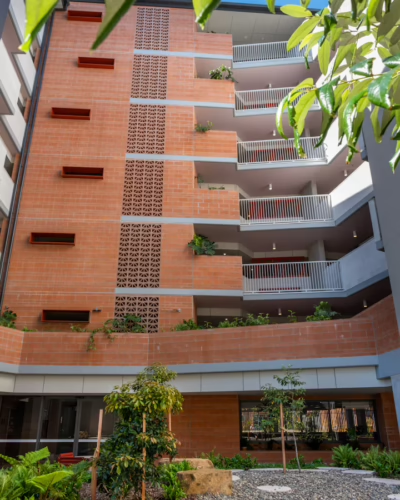
Redcliffe Social Housing (Solstice) by Arkhefield responds to a very different set of needs. Designed for older Queenslanders, including older women and downsizers, the project brings together accessible homes and shared spaces that support social connection, neighbourly interaction and ageing in place. The design reflects an understanding that housing is not only about shelter, but also stability, dignity and belonging.
At the scale of a single home, Emoji House by Reddog Architects was shaped by its clients’ desire to maintain strong connections with their neighbours. Its frontage balances openness and privacy while responding to the character of the surrounding suburb, showing that careful listening can be just as important in a private residential project as it is in a major civic one.
Taken together, these projects show that listening can shape architecture in very different ways. It can influence how spaces are arranged, how people gather, how culture is expressed, how privacy and connection are balanced, and how a project responds to the practical realities of everyday life.
The architect’s role in this process is not simply to arrive with an answer. It is to ask good questions, understand different needs and perspectives, and bring those conversations together in a coherent response.
Why an architect?
Architects can help clients and communities turn diverse and sometimes competing aspirations into a built outcome. That involves design skill, but also listening, interpretation, facilitation and collaboration.
Explore the 2026 Queensland Architecture Awards digital book HERE