
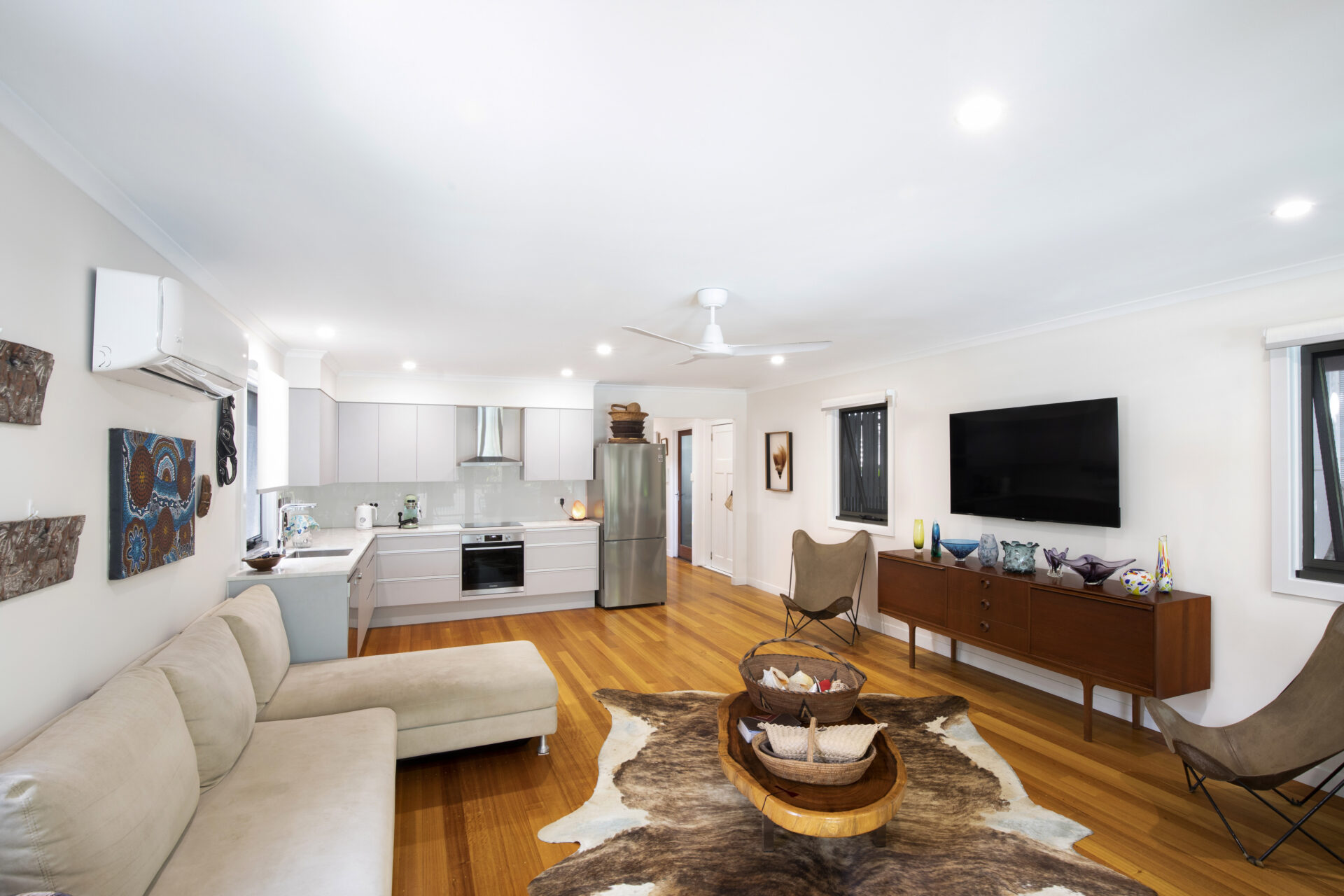
The 2022 floods left their mark. “We had fish in the pool, and the boys shovelled multiple skip bins worth of mud from out under the house and pool,” the homeowner recalls.
Flood resilience wasn’t the only consideration at the heart of this project. The owner is in a wheelchair, so functionality was key.
The home is spread over two levels with the owner’s son and family living upstairs while she occupies the one-level space downstairs.
The biggest challenge was the damage to her lift and its control panel. Compounding matters, the elevator company she used had also flooded.
No workable lift meant it was seven months before the homeowner could access her home to inspect the flood damage.
During that time, she started researching resilient strategies for her home.
Raising the lift control panel from downstairs to the upstairs space was one of the most significant resilient improvements made.
Other modifications are further examples of what flood-resilient building design can achieve.
Her floors were already hardwood timber, so didn’t need replacing. The kitchen was built back with marine ply, with two-pack sealing for flood resilience. Removable kickboards can be taken off before or after a flood event and the area hosed out easily.
The existing pine frame cavity walls were painted to help with future cleaning and prevent mould growth, while internal walls were replaced with fibre cement sheeting.
The bathroom is a beautiful space with floor to ceiling tiles and epoxy grout, and the vanity unit is suspended on stainless steel legs.
“We treated the bathroom like a swimming pool – with the tiles, adhesives and epoxy grout all water resistant,” says her builder Steve Arlidge, of Arlidge Constructions.
“In the homeowner’s case, as well as being resilient it had to be functional for her. It’s all custom built and resilient, so if a flood comes it should just be a matter of hosing the water out.’’
For the owner, it’s brought some peace of mind.
“I’ll probably always have PTSD about water, but this has made a massive difference.’’
The homeowner’s home is featured as a case study in the Queensland Government’s updated Design Guidance for Flood Resilient Homes.
Architect: N/A
Project: Retrofit Program, Resilient Homes Fund, Department of Housing and Public Works
Location: Brisbane, Qld
Builder: Arlidge Constructions
Date: 2025
CASC Green Digest project lead: Sophie Barrett
Links to further reading: