
House on a Path | Joanna Nelson Architect

A 1970s house on an experimentally planned suburban site in Canberra has been reorganised and reoriented through two precisely placed but loosely programmed additions to front and rear.
Japanese influences are evident in the original house and courtyard and Radburn planning principles in the battle axe block the unfenced front boundary is to a public pedestrian path while the rear driveway leads to the street.
The principal architectural idea is to amplify these distinctive attributes while providing legible entries and introducing circular routes.
The additions internalise seven external openings slotting under the existing eaves to the rear and matching the footprint of a demolished deck to the front. The additions function equally for utility, or to detour, gaze out and welcome in.
Inside, these circular routes enrich living patterns while outside, a new circular path skirts a new pool and gathers up narrow and generous spaces into a continuous whole.
Huntington | SJB
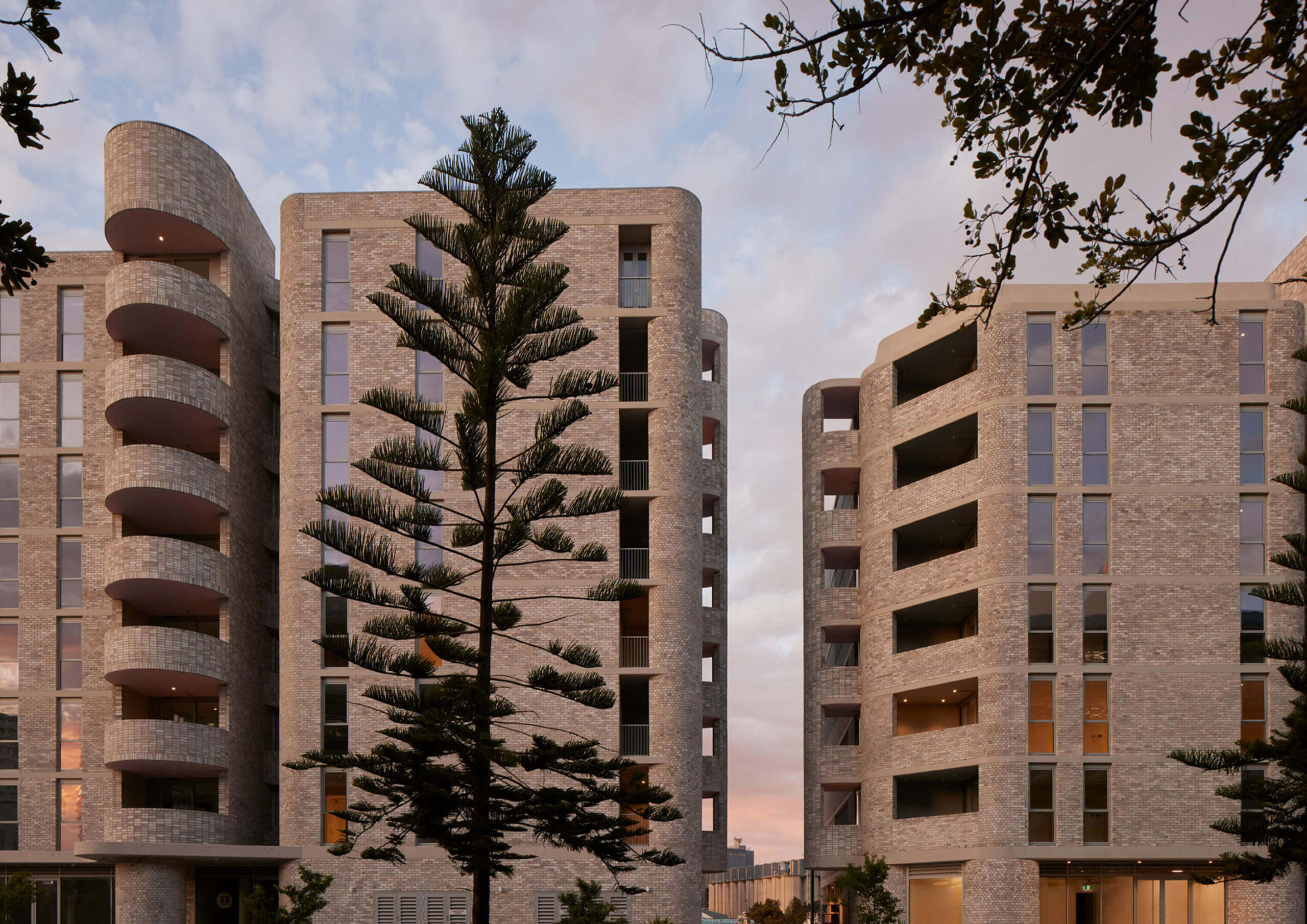
Running parallel to the Hunter River, Huntington at 35 Honeysuckle Drive is a key node in the Newcastle Honeysuckle Precinct urban renewal corridor, evolving the foreshore into a highly connected, mixed use precinct. Poised to play an important role in enlivening the precinct this new residential development introduces significant retail to the ground plane and 90 apartments above, across two buildings.
The success of the Honeysuckle precinct is intrinsically linked to the connectivity between the city and the water’s edge and its activation. Huntington stitches the old town at the south to the foreshore boulevard through permeability and the introduction of protected, north facing retail spaces. The material palette also speaks to the site’s differing conditions, with a playful brick façade facing Honeysuckle Drive which opens to the north to capture views and light and reflect the palette of industry across the river.
Hurlstone Memorial Reserve Community Centre | Sam Crawford Architects
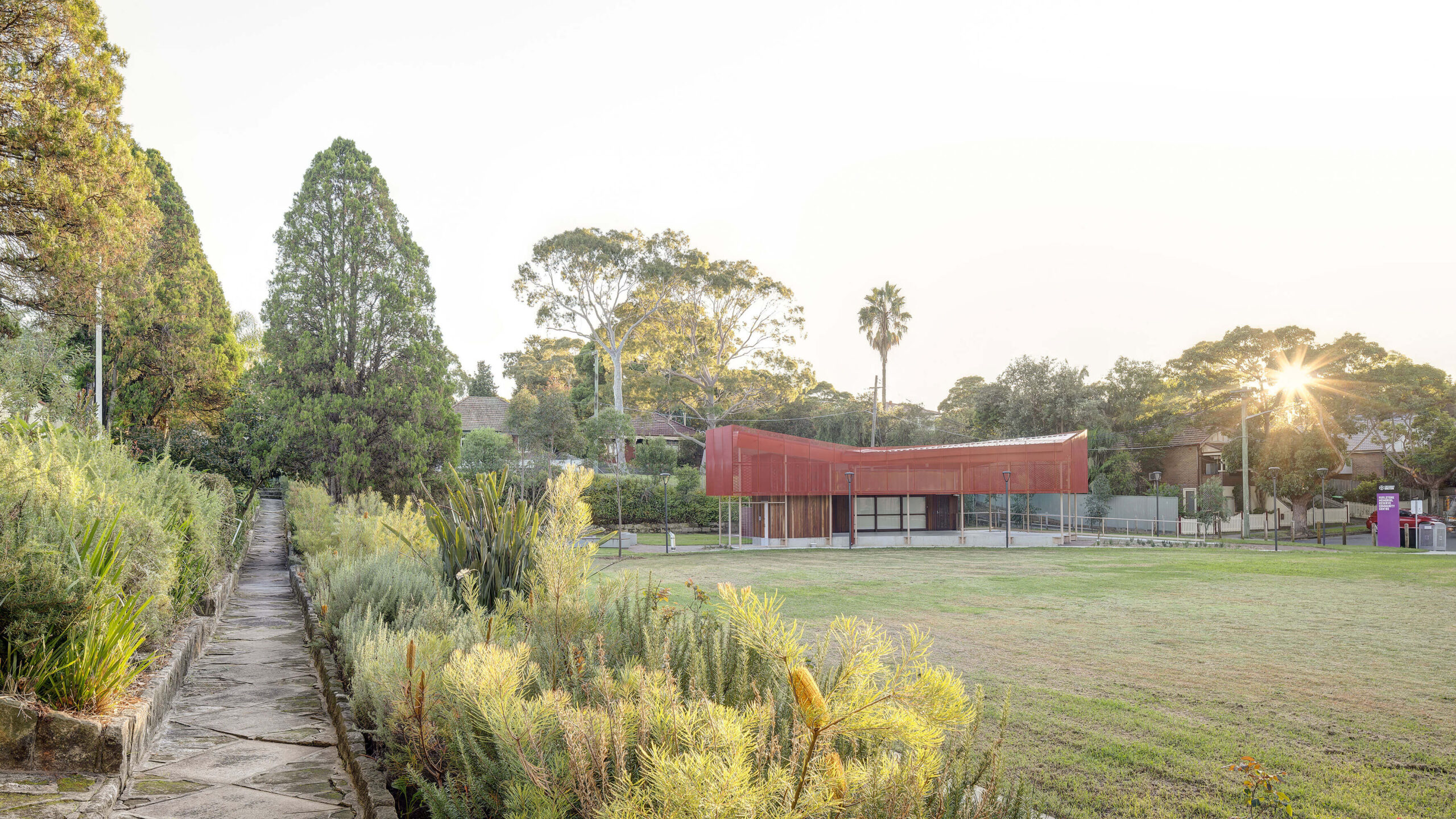
The soft Y shape of the Hurlstone Memorial Reserve Community Centre welcomes the local community with multiple access points and vistas.
The shape of the building minimises the building mass, allows views through the building from key park entry points whilst framing views to all areas of the park.
The layout also allows spaces around the building to be maximised for public use. Each side forms a sheltered courtyard, and facilitates circulation around the building so that no one side is the back.
The pavilion is lifted off the ground to avoid flooding and to provide seating around the edge. The three curved sides feature large glass doors adding transparency, cross ventilation, and accessibility.
Perforated screens on the roof and undulating facade create a lantern effect offering views out and up, bringing light in, and promoting safety. The materials, colours and forms complement the Federation heritage of the area.
Hurlstone Park House II | CMA – Carla Middleton Architecture
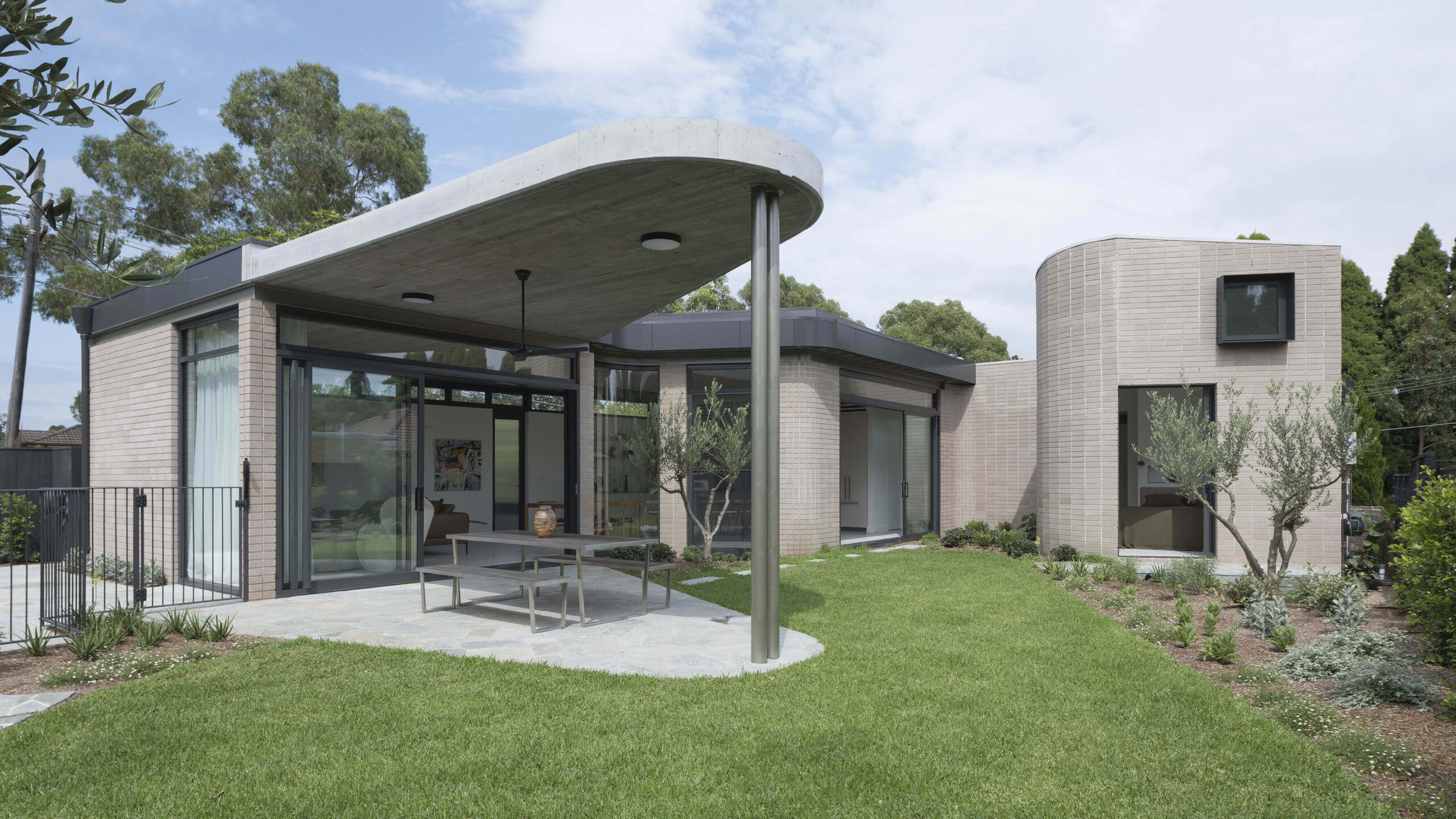
Hurlstone Park House II is a renovation to a single storey Federation home located on a corner block in a heritage conservation area in Sydney’s Inner West. The original building form was retained and a new single storey addition runs along the side southern boundary, providing privacy from the secondary street frontage while allowing the living spaces to open up to the north.
The built form has been pushed and pulled to allow for four private courtyards that create a sanctuary for its occupants and enhances the project’s connection to the garden. The curved and wrapping built form allows for varied living spaces where the family can both come together and retreat. The addition’s scale responds to the sloping corner block and respects the existing streetscape context with an appropriate and subtle contemporary addition that is highly functional, with every space carefully designed to meet the client’s needs without excess.
Ibbetson House Additions | Max Pritchard Gunner Architects

After purchasing a State Heritage listed house in the inner city, our clients’ wanted to substantially increase guest accommodation, garaging and add a modern light filled living area / entertaining space. Even for this relatively large block clever space planning was a necessary to include all their requirements without dominating the original heritage structure.
At the rear is a two-level addition, with a large living area opening out to a carefully landscaped courtyard and swimming pool. A large, glazed roof section shafts winter sun into the living area with an external blind providing summer shade. A wall of locally sourced random stone encloses the rear of the courtyard and extends through the lounge room, tying the interior and exterior to add to the feeling of space.
A two storey structure and with an undercroft presents as a distinctly separate modern structure, neutral and neat, not dominating the finely detailed original house.
Iglu Mascot | Bates Smart
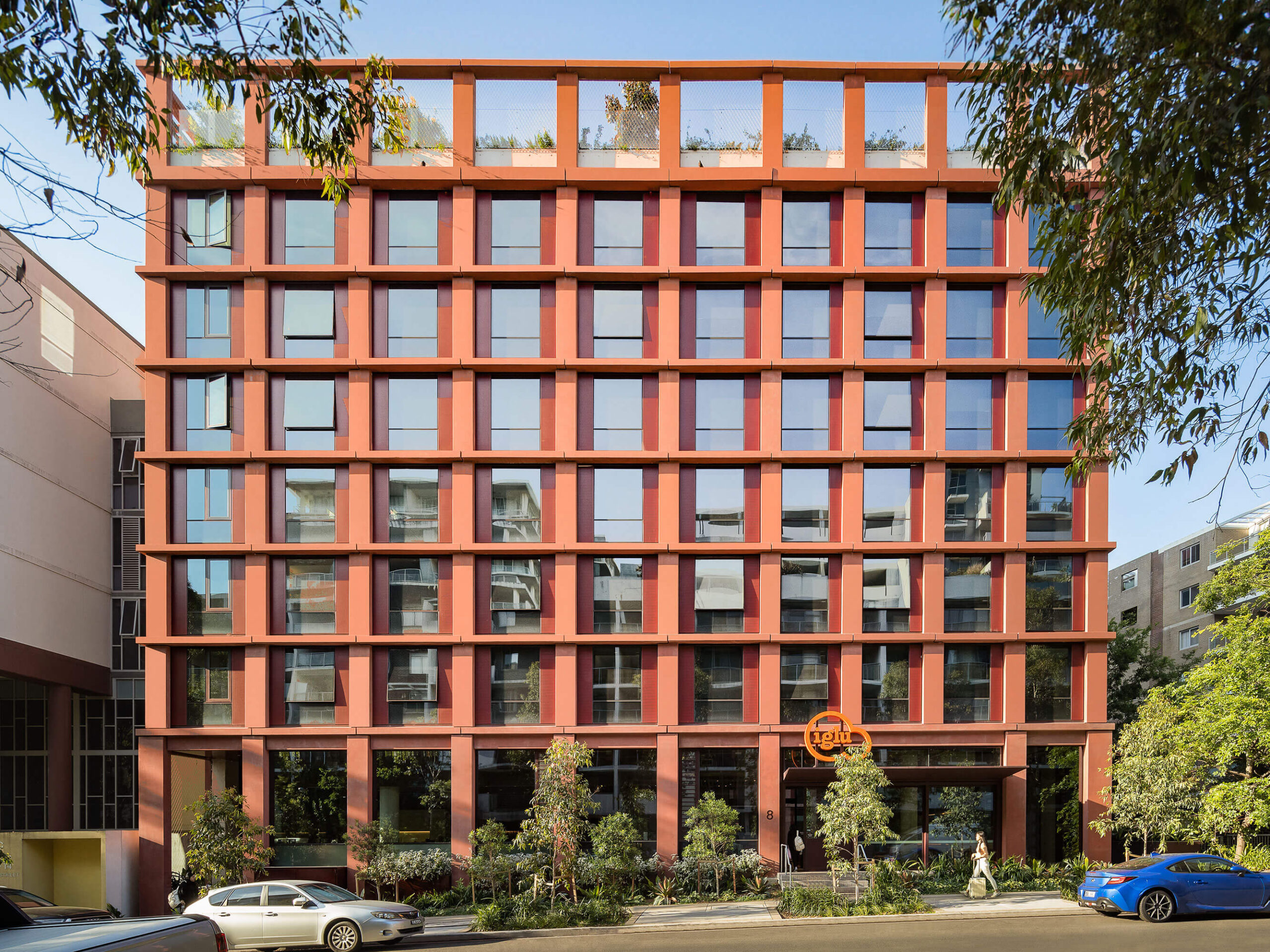
Iglu Mascot’s architecture center’s on community in two ways. The building provides a much needed, high-quality home to more than 430 university students, close to Mascot Station. It also works hard to lift Mascot’s built environment, which is dominated by bland residential super blocks, traffic congestion, and a lack of open green space.
Three interconnected rectilinear volumes of varying height are organized around a landscaped courtyard. The volumes are wrapped in a precast concrete grid that embraces the modularity of the apartments within. Colour is integral to the grid, each volume is identified by its own unique hue, drawing from a palette that references Mascot’s older homes and brick warehouses.
Inside, the building balances efficient studio and 6xbed cluster apartments with generous shared amenities that support study and promote community. Communal outdoor spaces and soft landscaping have been maximised to improve liveability and set a new precedent for neighbourhood architecture.
Hackett Gardens House | Ben Walker Architects

The project comprised the design of a new single storey house in the northern Canberra suburb of Turner. The building forms a U shaped plan with an internalised large central court. This layout provides the desired privacy from the public realm, but allows for open and generous views from living spaces into the central court.
A series of indented solar courts provide light and refuge between the wings subtly demarcating the transition between zones and providing foreground views to landscape. Saw tooth roof elements contain highlight windows that provide northern sun to rooms that may otherwise be landlocked and generous interior volumes.
The 8 star house includes highly insulated triple layered walls. Ceilings and burnished concrete slab are heavily insulated, with both internal and external membranes providing excellent air tightness. Windows integrate high performance triple glazing and a PV system provides a substantial portion of household energy use.
Hale St Alterations & Additions | Philip Stejskal Architecture
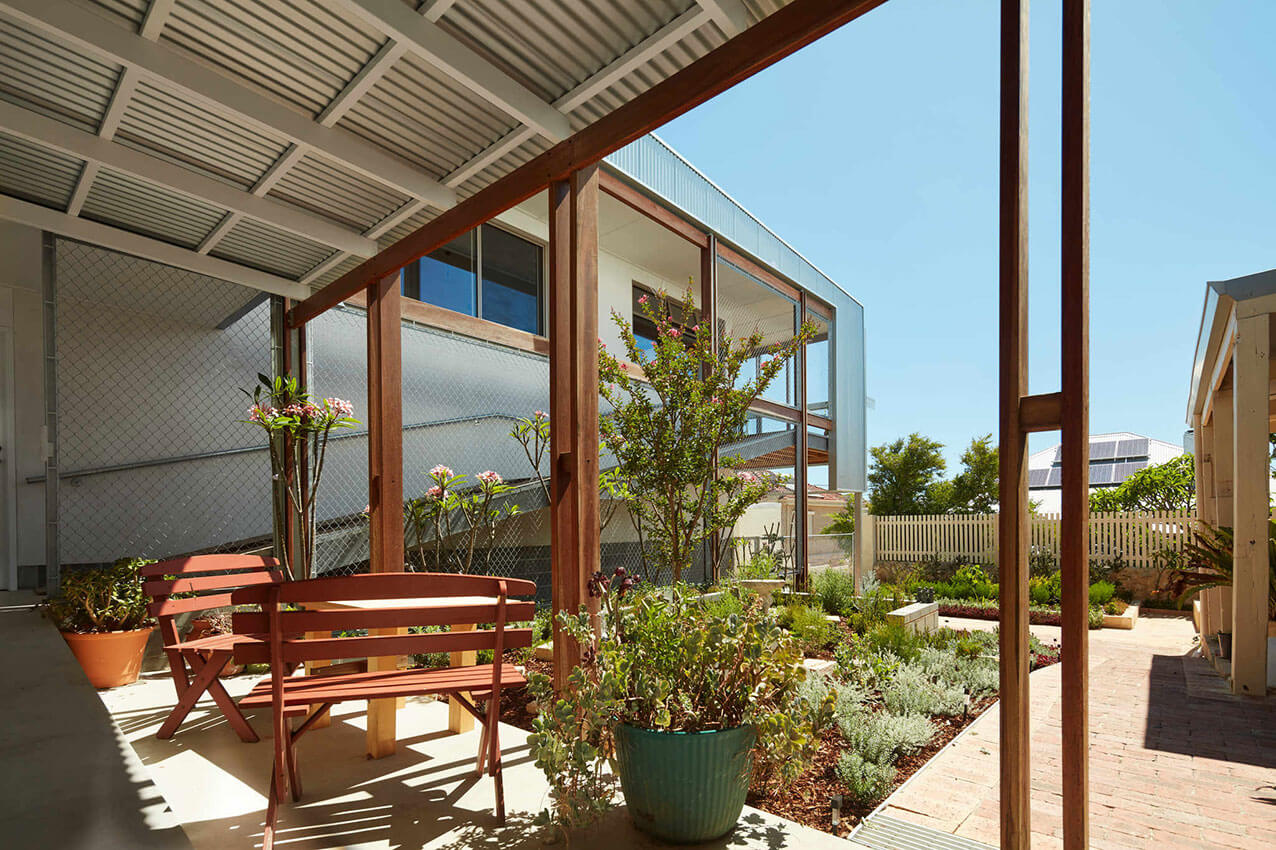
A project conceived around our clients’ desire to live out the rest of their lives here. Recently retired empty-nesters, Trish and Rob had aspirations for a forever home that was comfortable to live in, maintenance friendly, captured the panoramic views to the Indian Ocean, yet maintained strong connections with the garden that was to become a focal point of the site and their lives.
A sloping site led to a split level home connected by a series of ramps, weaving various interior and exterior spaces into a cohesive whole.
In pursuit of strong environmental credentials, Hempcrete became a key building material and part of the project, able to provide high levels of insulation, building sealing and indoor air quality. A series of other materials were used around the Hempcrete to protect it from the elements and to create a home that would age gracefully.
Hames Sharley Darwin Studio | Hames Sharley NT Pty Ltd
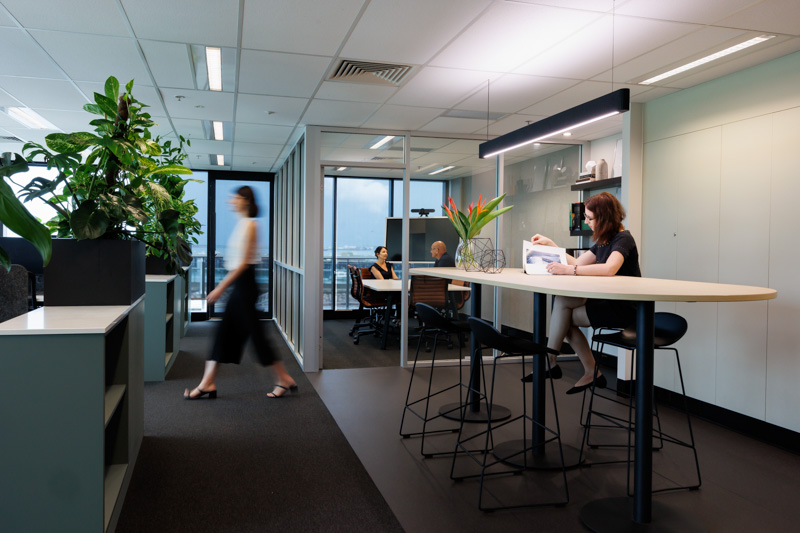
Hames Sharley’s Darwin Waterfront Studio is a welcoming and inspiring space for staff and guests, where creativity and collaboration thrive. Informed by an imperative to create an environment conducive to sensory comfort and seamless collaboration, the design draws on the practice’s extensive research and experience in sensory workplace design.
The entry provides guests with a sense of arrival, with Victorian ash battens and handmade light pendants. Internal and external glazing provides transparency and connectivity to the water views and floods the studio in natural light. Clear sightlines provide constant glimpses of the harbour and workpods have been configured to take full advantage of the natural light.
Calm textures, finishes and colours reflect and extend the view of the surrounding harbour, foliage and cliffs. Ottomans in prints by Indigenous artists embody the colours of Larrakia Country.
The new studio showcases modern workplace design, while prioritising staff wellbeing.
Hanson’s House | XAAP Design Pty Ltd

The project is meticulously crafted for an architect’s personal residence. The duplex layout is artfully configured to optimize privacy and minimize interference between the two households, strategically positioning entrances and backyards. Drawing inspiration from a vertical wave concept, the building facade elegantly complements its surroundings. Softened corner principles extend to both interior and landscape design. The structural integrity of the building is underscored by the use of 50 tons of steel, facilitating large spans and cantilevers. The external walls, constructed with Ductal from Holcim, boast Concrete C120 strength, ensuring durability and resilience. Furthermore, double layer insulation and double-glazed window systems contribute to significant energy savings. Prefabrication technologies streamline construction, reducing onsite labor and environmental impact. The building cost is balanced by strategically increasing material costs while reducing onsite labor work time. This approach ensures optimal efficiency without compromising on quality or structural integrity, ultimately contributing to a cost-effective yet high-quality final product.