
Shoreham House | Noxon Architecture

Shoreham House reimagines a midcentury twostorey beach house by extending an existing bluestone cottage, elevating coastal living upwards into the tree canopy amongst the air, light, and breeze.
The new extension is drawn out from the bluestone cottage, cantilevering over the floodprone land, and creating an open and connected landscape below. Steel V columns raise the new extension into the treetops above, reflecting a traditional beachhouse typology and celebrating the language of the sites abundant forked eucalypts and foliage. The cottage renovation retains its beachshack simplicity, while the new architecture is wrapped in a recessive dark envelope that reveals a warm, light timber interior.
Six Chimney House | Vokes and Peters

Improving early twentieth century housing is a recurring project type which calls for an appropriate response to the specific and evolving societal, cultural, environmental and economic contexts.
The palette of the heritagelisted interwar bungalow was adapted and abstracted in the new works. Each trade is elaborated in the composition, in the manner of the arts and crafts movement.
The elevated ‘Street Terrace’ maintains the leafy character of the neighbourhood. By placing the new kitchen into the former front room, the social life of the family spills out onto the street terrace and enables one to feel a part of the city.
The ‘City Terrace’ is a private outdoor space that offers an unexpected place of prospect.
A façade of many windows sits in constant dialogue with the panoramic view of Perth CBD.
The ‘Sunken Garden’ is imagined as a cool, shady forest supporting biodiversity and idealising the presence of nature.
Smith House | Fowler and Ward
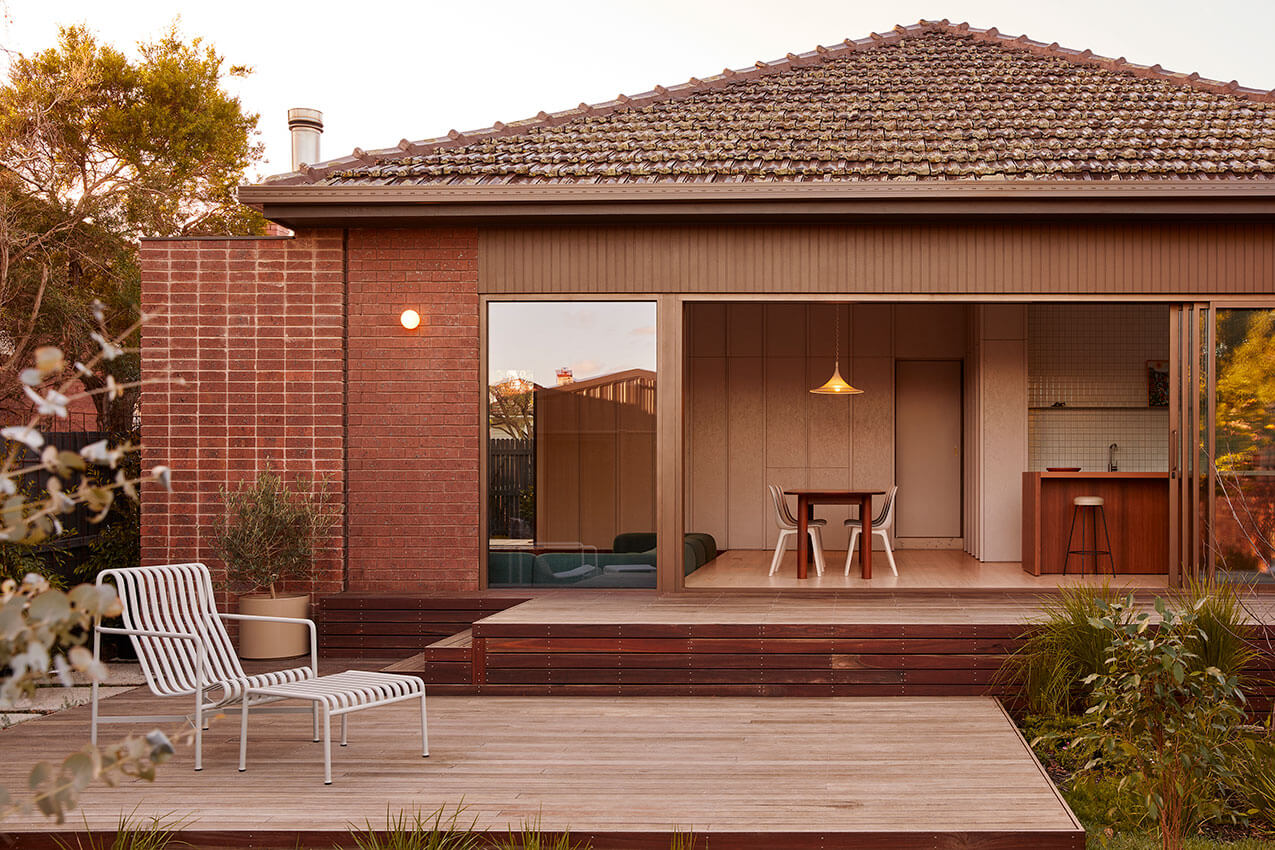
Smith House is a project that celebrates, rather than reinvents an underappreciated era of housing; the ubiquitous, brown brick, tiled roof, free standing suburban home.
Tucking in beneath the western eaves and dropping below the existing floor level, a modest 8m2 extension transforms the home. The design reorients the interior to its garden, bringing sunshine inside and opening up what was a highly segmented floor plan. Quality, not quantity of space is the priority.
Small interventions celebrate the homes character and offer an alternative to the usual; paint, render or demolish. Tesselated tiles, amber glazing and diagonal timber cladding peek out from the front arches while recycled and reclaimed brown brick is celebrated in the extension, laid in stackbond to delineate itself from its predecessor. The project demonstrates how working within an existing envelope and embracing character results in a delightful way of living without rebuilding.
South Perth House | Simon Pendal Architect
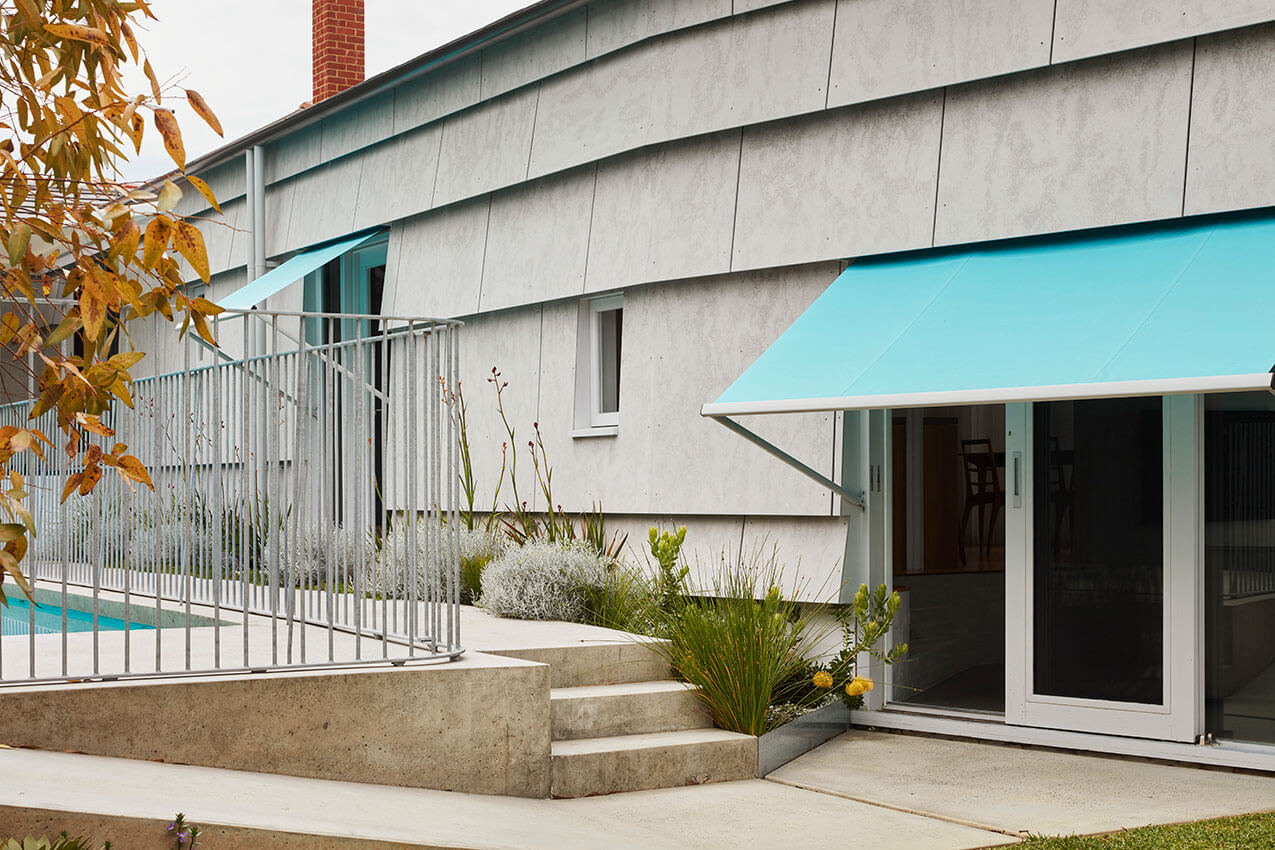
An existing 1930s Arts and Crafts bungalow has been restored and extended. Passing through the centre of the original house the interior of the new addition is thick (like a castle) but is mostly white, fluid and undulating. Light rolls around soft curves. The addition is a long sequence of rooms the floors cascade down the natural fall of the site. There is one room per level divided by short runs of four or five steps each. The rooms contract, expand and contract in scale depending on the intimacy required in each space. Floors in each room offer a material density in contrast to the billowing white interior of walls and ceilings above. Each room is correlated to a different sequence of gardens a pool, a shady summer clearing and an outdoor living room under a concrete rotunda.
Regent Street Extension | Preston Lane
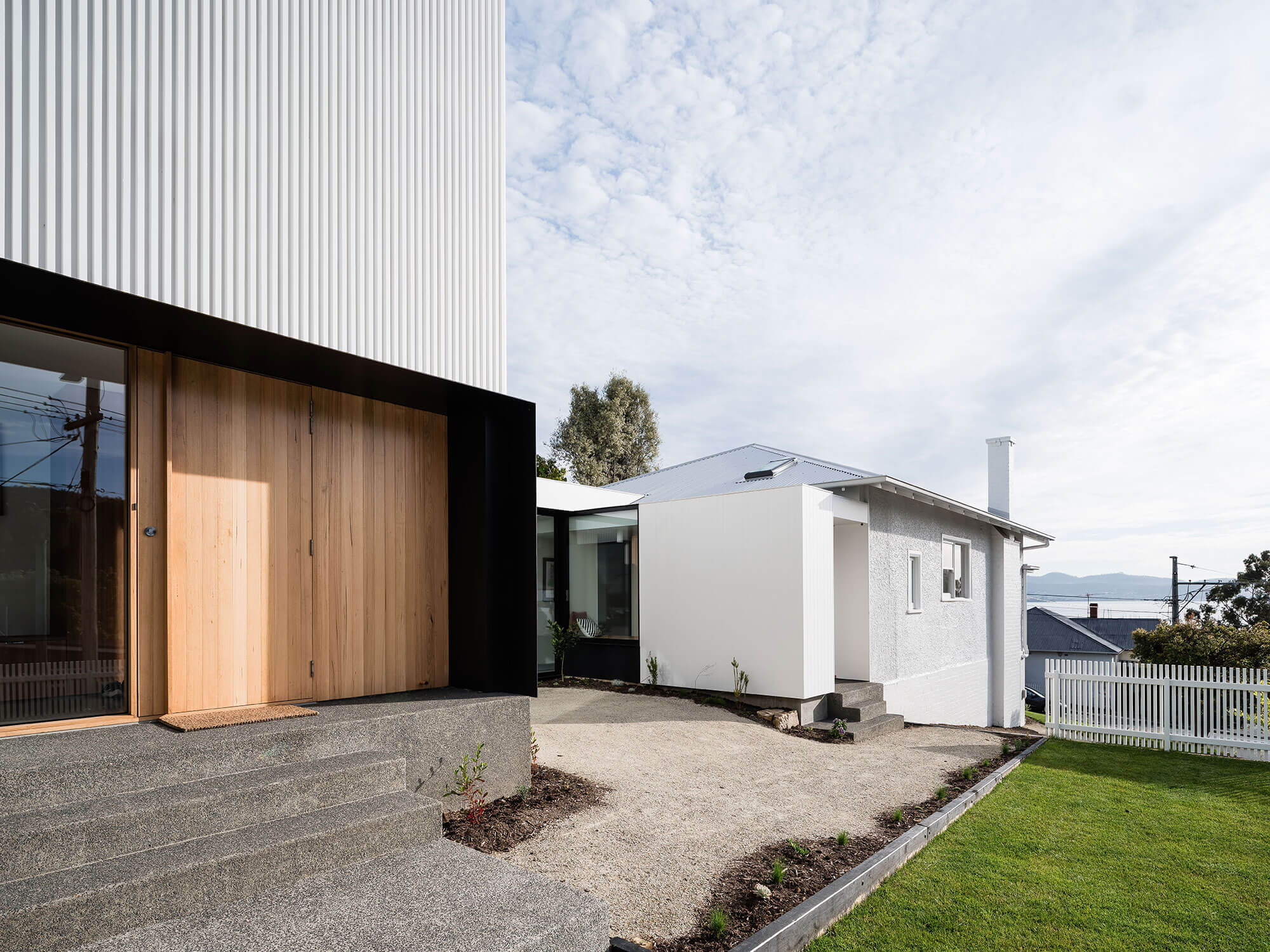
Located on the roundabout of a suburban arterial road in the heart of Sandy Bay, the extension steps up the slope of the corner site as it opens to the North enabling privacy for the occupants and distance from the noise of the road below.
Preston Lane was engaged to modernise the property to provide spaces for a growing family currently residing in Singapore. The extension included the revitalisation of the existing character home (back to its original form) and a substantial rear extension. An existing twolevel extension was removed as part of the works to reveal the original dwelling and to enable a better relationship between the internal and external spaces within the new works.
A new entry has been created off Alexander Street, providing greater connection to the homes new Living spaces housed within the new works, whilst a subtle side entry from Regent Street has been maintained.
Riverbend Repair | Vaughan Howard Architects

River Bend House sits atop an ecologically and culturally significant escarpment on a bend in the Birrarung (Yarra River), part of the Garambi Baanj Cultural Precinct, established and operated by InPlace in partnership with the Wurundjeri Woiwurrung Cultural Heritage Aboriginal Corporation and Parks Victoria.
Designed by Alistair Knox in 1968, River Bend had fallen into a state of disrepairhaving been unoccupied for over eight yearsprior to InPlace launching this ambitious vision. River Bend now operates as a place of artistic and cultural production for multidisciplinary artists and Wurundjeri.
The original approach to River Bend was repair, evoking the functional and pragmatic. Since completion, First Nations artists have described River Bend as a healing place, indeed the notion of healing extends across the project: healing Country, healing disrupted culture practices, and healing the self. The repair of River Bend has provided a safe space for healing journeys.
Point Piper House | Tony Owen Architects
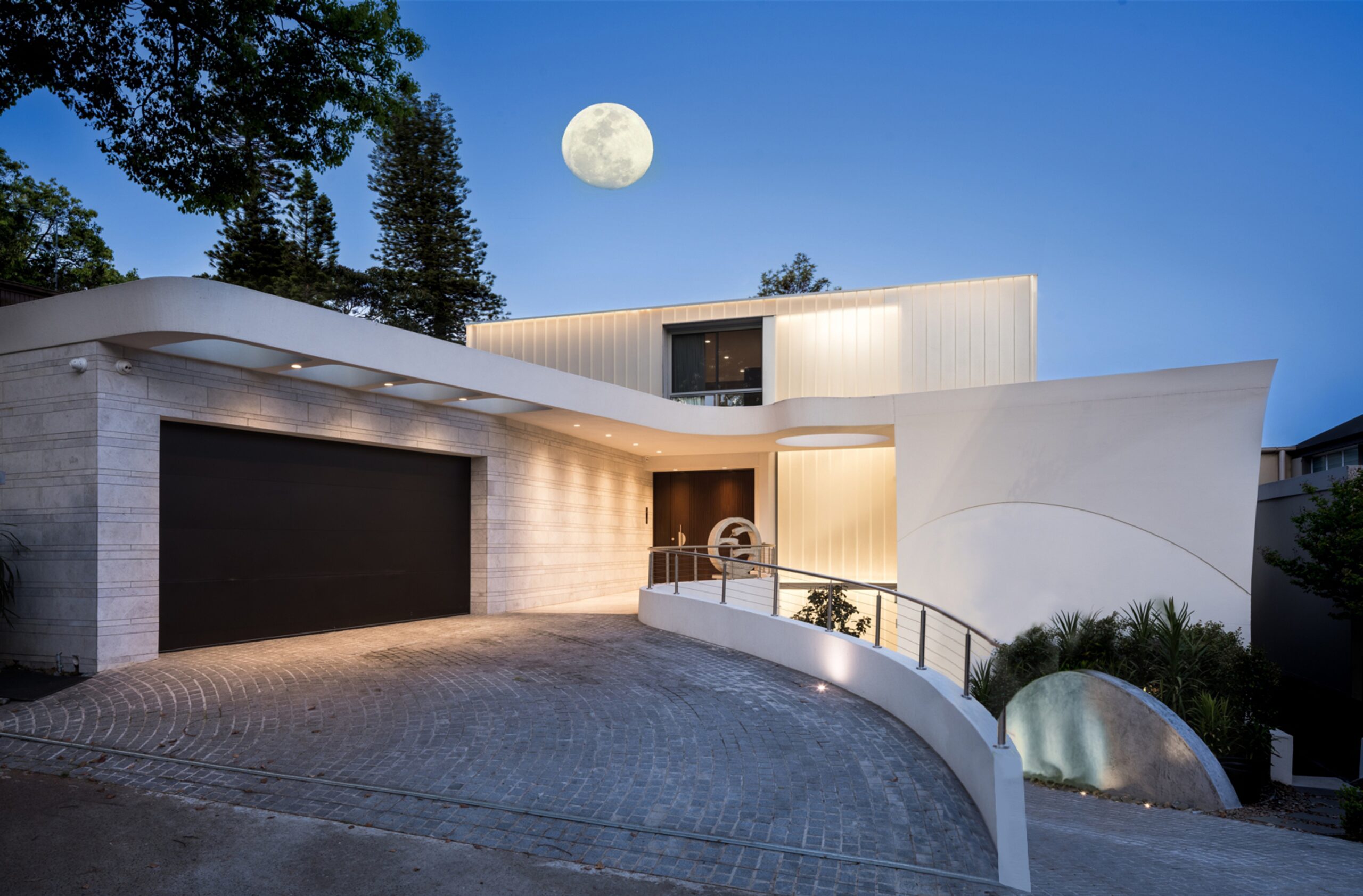
The client sought a much lighter and very luxurious home. The first challenge was to re-unify the house by connecting all levels using a steel spiral staircase. We then rationalised the structure introducing fewer columns, and simpler beams. This resulted in a very clean and open flow. The top floor was changed to a master bedroom suite. The roof terrace was extended. The entire house was rendered. The uppermost level was reclad in transluscent profilit glass, which continued through the lower levels and the house was re-rendered and painted white. This considerably lightened the exterior and the large expanse of profile it and connecting voids lightened the interiors. The result is a luxurious dwelling that lives up to its prestigious address.
Quarry House | Winwood Mckenzie
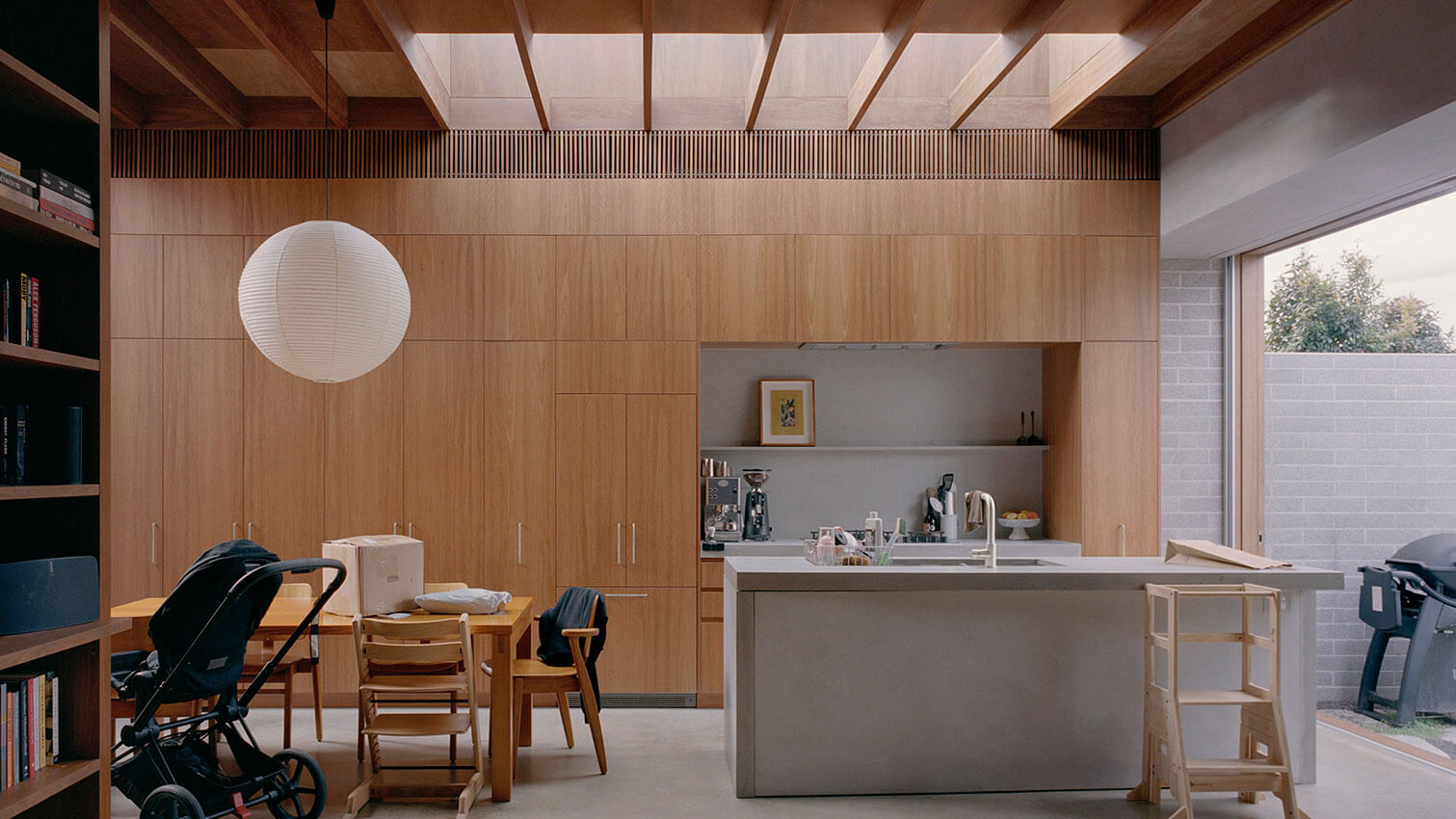
Quarry House is a response to sites constraints and historical use as a workers cottage and adjacency to the former Northcote quarry. Key considerations were resource use and how the reintroduction of light, air and vegetation could be achieved on the site. Introducing internal courtyards, where boundaries are defined by brick walls and life is brought back to the land and residence. Designing around the garden space allowed for a design that can expand and contract to adapt to functional requirements and future use. It manifests an atmosphere enriched by connections to landscape and detailed architectural craftmanship.
Queens Park | Downie North

Queens Park House pushes to the peripheries and sleeves into the gaps left over by the original semi detached house it adapts. The transformation of an enclosed, two bedroom house into a spacious, multifunctional home for a young family evolved to incorporate diverse needs from outdoor play spaces and the capacity to host extended family. The architectural response was to inhabit edges, using the unused, from occupying the existing roof void to minimize overshadowing and bulk through to the creation of a roof garden above an existing garage.
Communal areas follow a curvilinear plan, fluidly adapting programmatic needs to make the most of sunlight and sea breezes. A new outdoor terrace invites interior and exterior to merge, doubling outdoor space and prioritizing landscape and views without compromising privacy. Shaded openings, exposed thermal mass, and ventilated facade are complemented by the photovoltaic solar array, demonstrating a harmonious blend of functionality and sustainability.
Patrick Street | Andrew Campbell and Georgina Russell

The Patrick Street project involved a series of interventions in a c.1880 heritage listed terrace house in Hobart. The brief to contain the program within the existing envelope prompted a design approach of discrete ‘moves’ that sought to unlock the plan and provide broad functional amenity seemingly by doing as little as possible. These moves involved the reconciliation of routes and rooms, introducing new insertions designed as buildings in miniature, and functional double moves where a single design move responds to more than one functional requirement. Material selections were informed by the heritage response, with new and modified openings and thresholds constructed from steel serving as a contemporary language counterpoint to the existing masonry and timer fabric. The detailing of the new insertions was approached as an exercise in the use of plywood, standard timber sections and off-the-shelf mouldings as a method for developing a distinct language across the scheme.