
Victorian Student Ideas Prize
The Student Ideas Prize is an annual design and ideas competition open to all students undertaking an ACCA accredited Bachelor/Master of Architecture Course in Victoria.
The competition is an opportunity to provide recognition and encouragement to students across the architecture schools in Victoria by showcasing and promoting the outstanding contribution they are already making to the profession.
The design competition is intended to challenge entrants to explore ideas and to provide sustainable built environment solutions that will promote healthy and thriving communities.
The aim of the competition is to provide a project that is real, relevant and within the public realm—a project that is well suited to our next generation of architectural thought leaders and practitioners.
The 2026 theme focuses on improving the accessibility of the built environment for individuals with both visible and invisible disabilities. Students are challenged to approach accessibility not merely as a matter of compliance but as a catalyst for innovative ideas, fostering the creation of spaces that are inclusive and enriching for all.
2026 DESIGN BRIEF
As an ideas competition, students are encouraged to explore matters that engage with the political, environmental, and economic conditions surrounding contemporary big-picture narratives of our time and place, however students will also be expected to take on board and resolve at a more technical level the local issues and space planning requirements. This is an opportunity for students to interrogate and challenge the dominant paradigms to find new and better-fit solutions at all scales of inhabitation. (From space to place, from macro to micro, from global to urban/suburban to human—from all levels of occupation and inhabitation).
The competition program is also designed to:
- Encourage a better understanding of the role and responsibility of an architect,
- Promote a positive outlook regarding the profession’s support for undergraduates, and
- Provide student insights into the transition from education to the real world of the profession and practice.
ANNOUNCEMENT, PROMOTION AND PUBLICATION
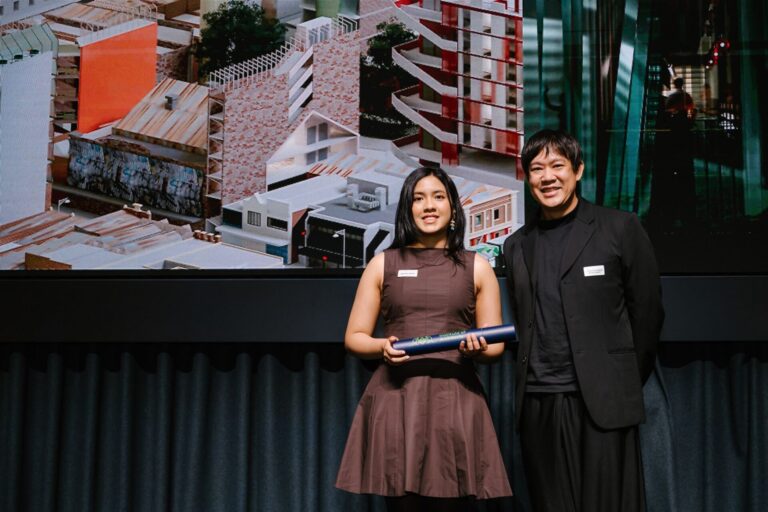
The Student Ideas Competition prize winner/s and commendations will be announced at the Victorian Chapter end-of-year event. The Victorian Chapter will promote the prize, projects, and winners through various mediums —such as the Victorian Chapter Instagram, e-news, and the Institute Website.
PRIZES
Student Ideas Prize Winner
- Certificate
- Cash prize
- 1 year of Institute membership (must be redeemed within 2 years of receipt of prize)
- 1 complimentary ticket to the annual Victorian Chapter end-of-year event or equivalent
Commendation(s)
- Certificate
- Cash prize
2026 ELIGIBILITY
The Student Ideas Prize, an annual design and ideas competition organised by the Australian Institute of Architects, is open to students currently enrolled in an AACA accredited Master of Architecture Course in Victoria.
Eligible institutions include:
- Deakin University
- Monash University
- RMIT University
- Swinburne University of Technology
- University of Melbourne
1st and 2nd year Masters students can participate in the competition through either a designated studio or by independently developing studio work. Both individual and group entries are welcome.
There is no restriction on the number of entries per school. An impartial jury will evaluate all student submissions based on predetermined criteria. The jury will identify one overall winner and may confer up to three commendations.
SUBMISSION REQUIREMENTS
Each student is to submit:
- 1 x 7-minute maximum pre-recorded Mp4 video Pecha Kucha format presentation
- 4 x A2 high-res landscape-orientated presentation boards in multi-page PDF format, Max 10mb
- 1 x 200–300-word statement outlining the project’s design intentions including project title
Entrants are reminded not to identify themselves or their universities in any submission materials (including video presentation). You are required to provide your contact details in your submission email to the Victorian Chapter. Entries cannot be submitted via your university email address. Every file submitted must be clearly labelled with your project name.
Detailed submission requirements are in the official Terms of Reference – please click here for more details.
Please contact your University Representative or email [email protected]
JUDGING PANEL
An independent jury will judge all students’ work against set criteria, selecting one overall winner and awarding up to three commendations. The jury will consist of:
- Representative from the Office of the Victorian Government Architect
- Representative from a non-Victorian Education Committee
- Representative from the brief provider or relevant committee
- Victorian Emerging Architects and Graduates Network (EmAGN) co-chair
- The jury will review the submissions individually and rank the student’s They will then meet as a group to make a final decision. Members of the jury will also make declarations of interest at this meeting, coordinated by the Institute’s project manager.
- One member of the jury is expected to draft the citation for the winning
COPYRIGHT
Copyright of the designs and all material submitted by the Competition entrants will remain the property of and be vested in the individual entrants. The students and Schools will be entitled to acknowledgment whenever their entries are publicly exhibited or published.
For questions related to Victorian Chapter prizes and scholarships, please email [email protected]. Please include “2026 Victorian Student Ideas Prize” in your subject line.
| March 2026 | 2026 Student Ideas Competition Information Pack sent to the Universities |
| 10 July 2026 | Closing date for competition entries to be submitted online. |
| Sep-Oct 2026 | Judging Period. Jury meets to decide a winner |
| 16 November 2026 | The winner announced at the Victorian Chapter Honours event |
2024 Kean Sheng Khoo (University of Melbourne)
2022 Sam Shaw (University of Melbourne)
JUDGING CRITERIA
- Clarity of the project’s intentions/communication of ideas.
- Conceptual rigour, imagination, experimentation.
- How the proposal works at all scales from urban to human, macro to micro.
- How the design reflects a critical awareness of current architectural thinking.
- How the design works with the natural environment and with commercial realities to bring amenity and delight to the built environment.
- How the relevance of place and metropolitan periphery is interpreted.
- How the design resolves pragmatic issues of site, accommodation and structure.