
Fish River House | Incidental Architecture

Fish River House is on Gundungurra land, on a fertile strip of granite country adjacent to the Fish River; a capillary river flowing from the Blue Mountains.
The clients are second generation custodians of the site, with the intention to support the continuity of the gathering of four (living) generations of family.
Being near Oberon, the site is characterised by hot dry days in summer, and regular snow in winter. The house is required to provide a reasonable level of comfort, whilst balancing passive and active systems. orientation and solar access is deeply considered.
Spatially and emotionally, there is an intentional dialogue between prospect and refuge. View and protection are equally important.
One of the most satisfying aspects of this project is the way it helped encourage capacity within the local building community. The builder, certifier and most consultants were drawn locally from Oberon.
Fleming Park | fjcstudio
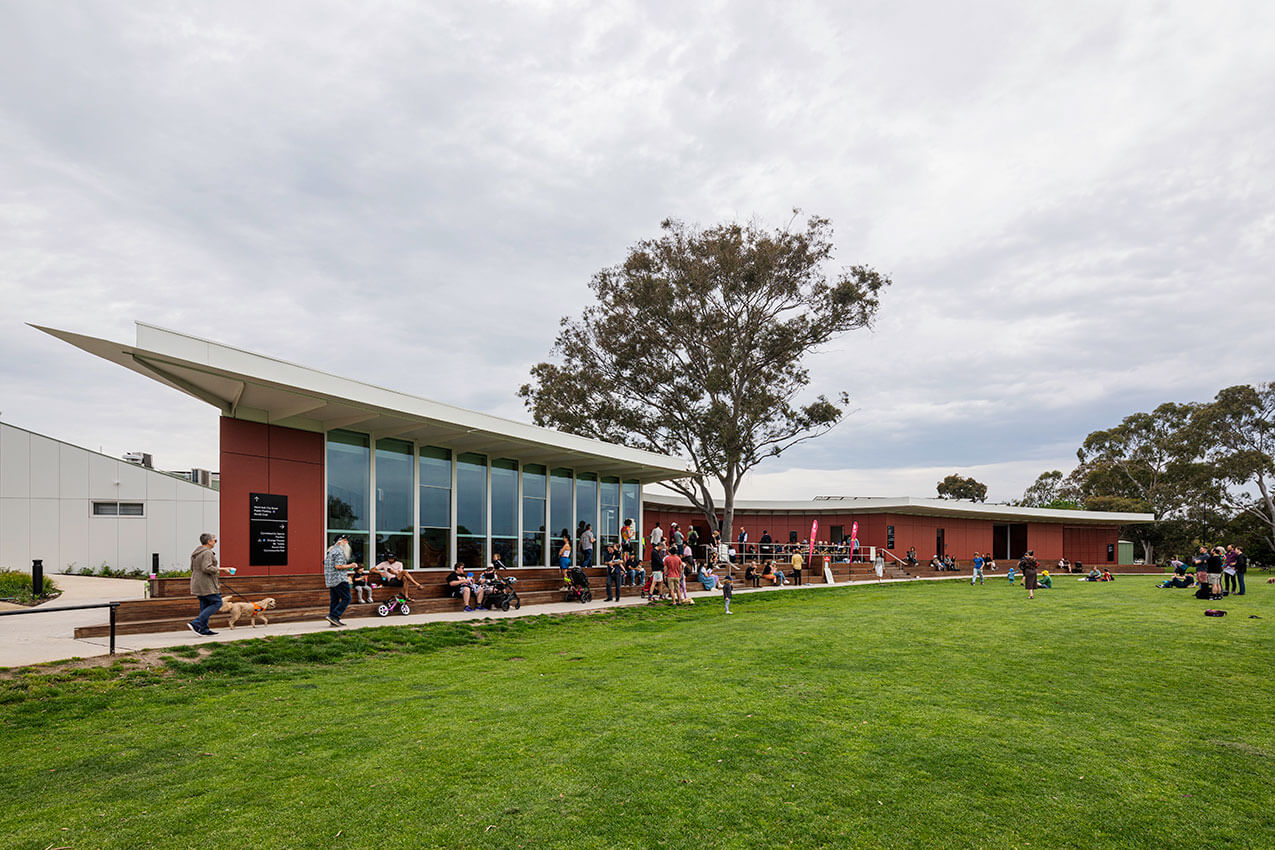
The principles of equity of access, welcoming, sustainability and respect for place were key to the Fleming Park project with the desire to create a place to be enjoyed by the broader Brunswick Community. Utilising a combination of existing and new buildings surrounded by mature trees creates a place of community ownership.
fjcstudios approach was to revitalise the entire Fleming Park Precinct which was tired and underutilised. A series of modest interventions such as the replacement of all noncompliant paths, new fencing, solar lighting and playground sculptures to separate from bike paths were undertaken. This was then complemented by two new buildings, a community sporting building and the restoration of an old derelict grandstand. In addition, a car park was converted into a basketball halfcourt and a rebound tennis wall with the remaining spaces into a series of Bio Swales and native garden play areas.
Forster Civic Precinct – Solaris | TVS Architects
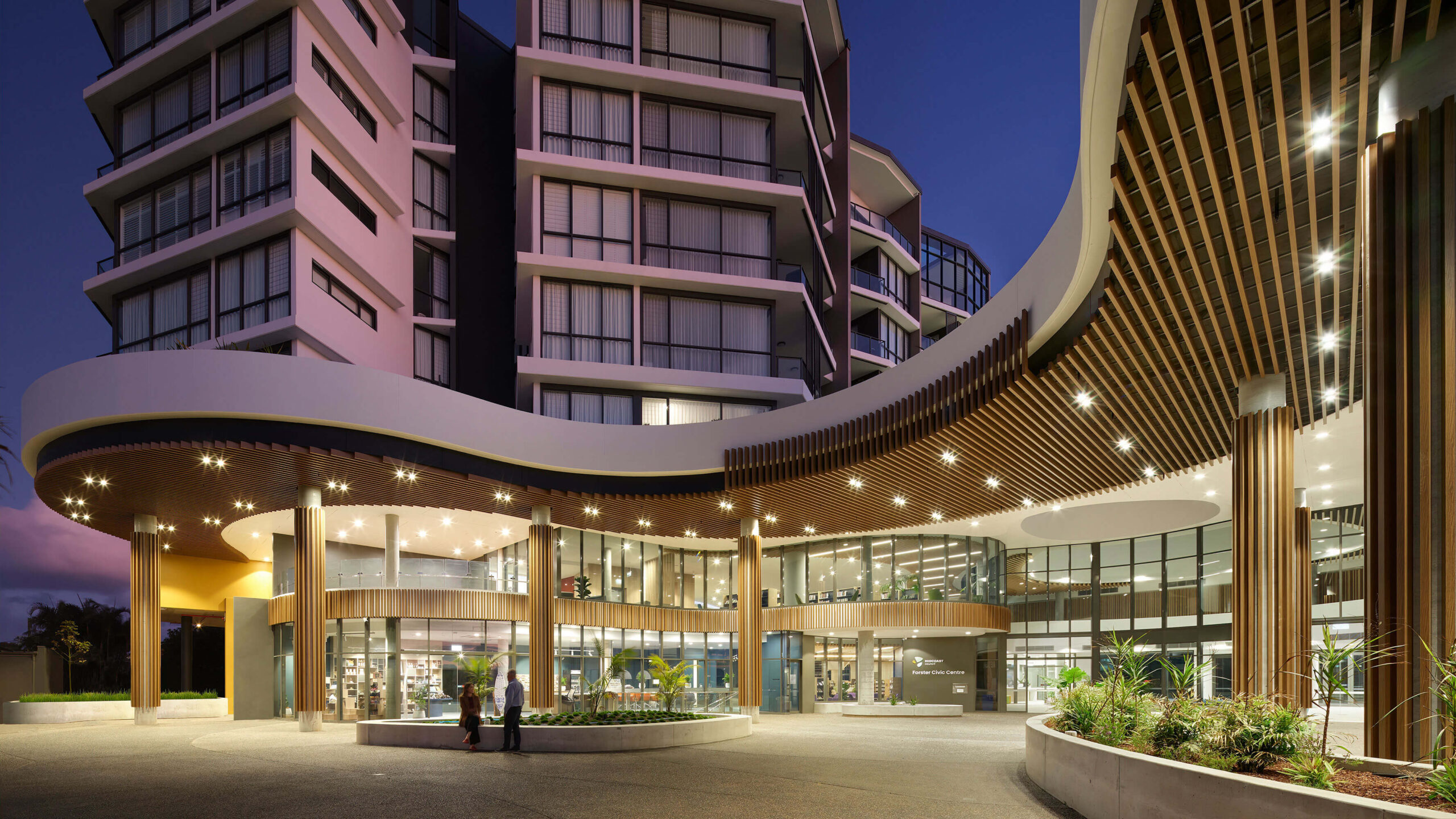
Solaris is a large mixed-use development that was initiated to facilitate moving the Council’s community facilities from a suburban site to this central beachside location. This first stage of the development comprises a residential apartment tower with 56 units, a restaurant and commercial space, and the Forster Civic Centre comprising a Library, Community Lounge, Visitor Information Centre and Customer Service Point for MidCoast Council.
The philosophy behind the master planned community precinct was to provide the community with a wide variety of amenities in an architectural context which facilitates adaptability and future flexibility for an evolving population. The diverse mix of uses futureproofs Solaris to better cater for the changing needs of an evolving population. The amenity enriches the public experience, creating a new social precinct to engage with the local community through its built form and presence near the lake and beachside commercial precincts.
Four Pillars Gin Distillery 2.0 | Breathe
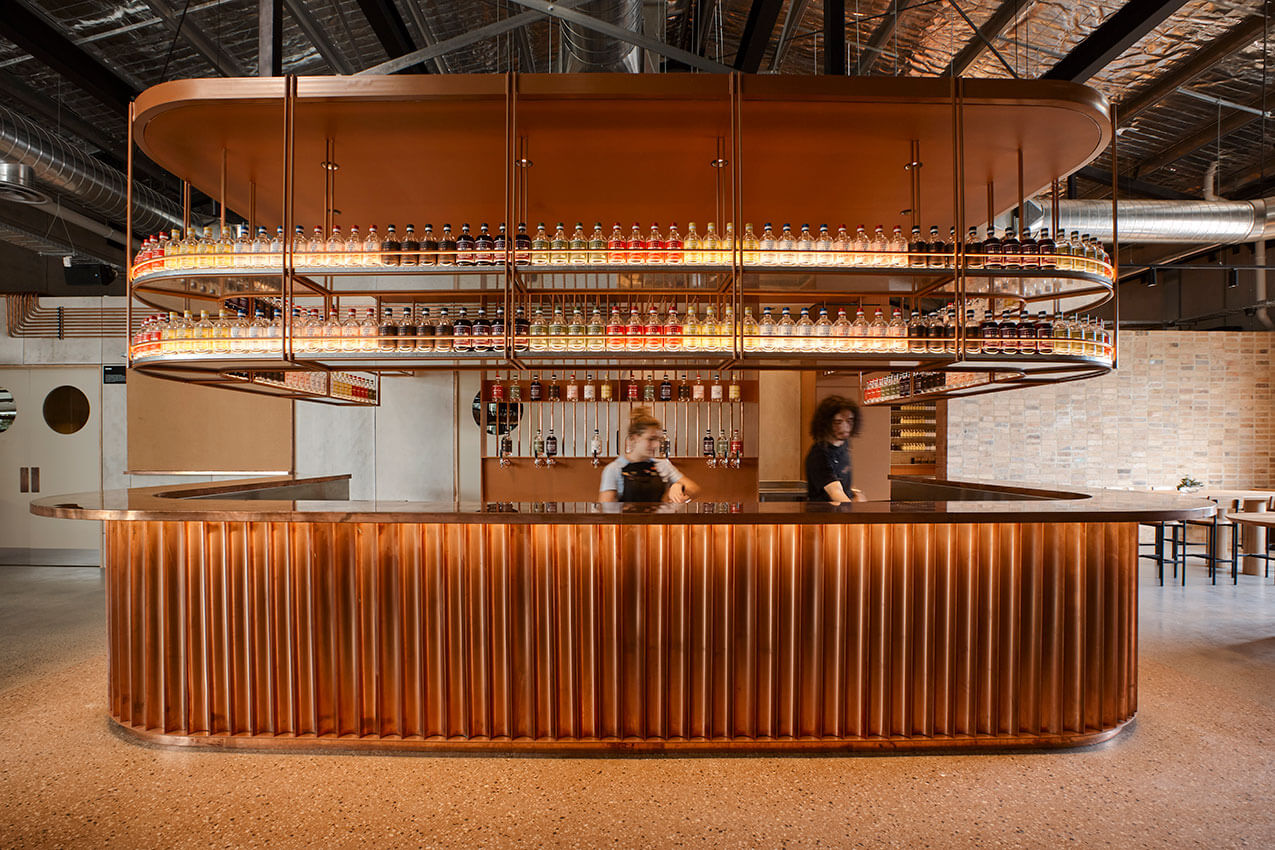
Breathe has joined forces with Four Pillars Gin to create a new, immersive gin experience in their birthplace, Healesville. Born and raised in this stunning part of the Yarra Valley surrounded by mountains, temperate rainforest, oaks, and elms, throughout the design we acknowledge Four Pillars origin, their history, and their deep connection to the place where it all began. 100% fossil fuelfree, a commitment to sustainability is honoured with a shift to renewable energy with rooftop solar, and 100% GreenPower. Made from the same material as the gin stills inside, a stunning copper veil wraps around the distillery working as a natural heat exchanger, creating an iconic entry moment with steam rising from the veil. The expansion delivers a muchneeded new production space, outdoor gin garden, tuckshop, dedicated gin shop, custombuilt bar, and sensational events space cementing Four Pillars firmly on the global distillery destination map.
Foveaux Street | Candalepas Associates
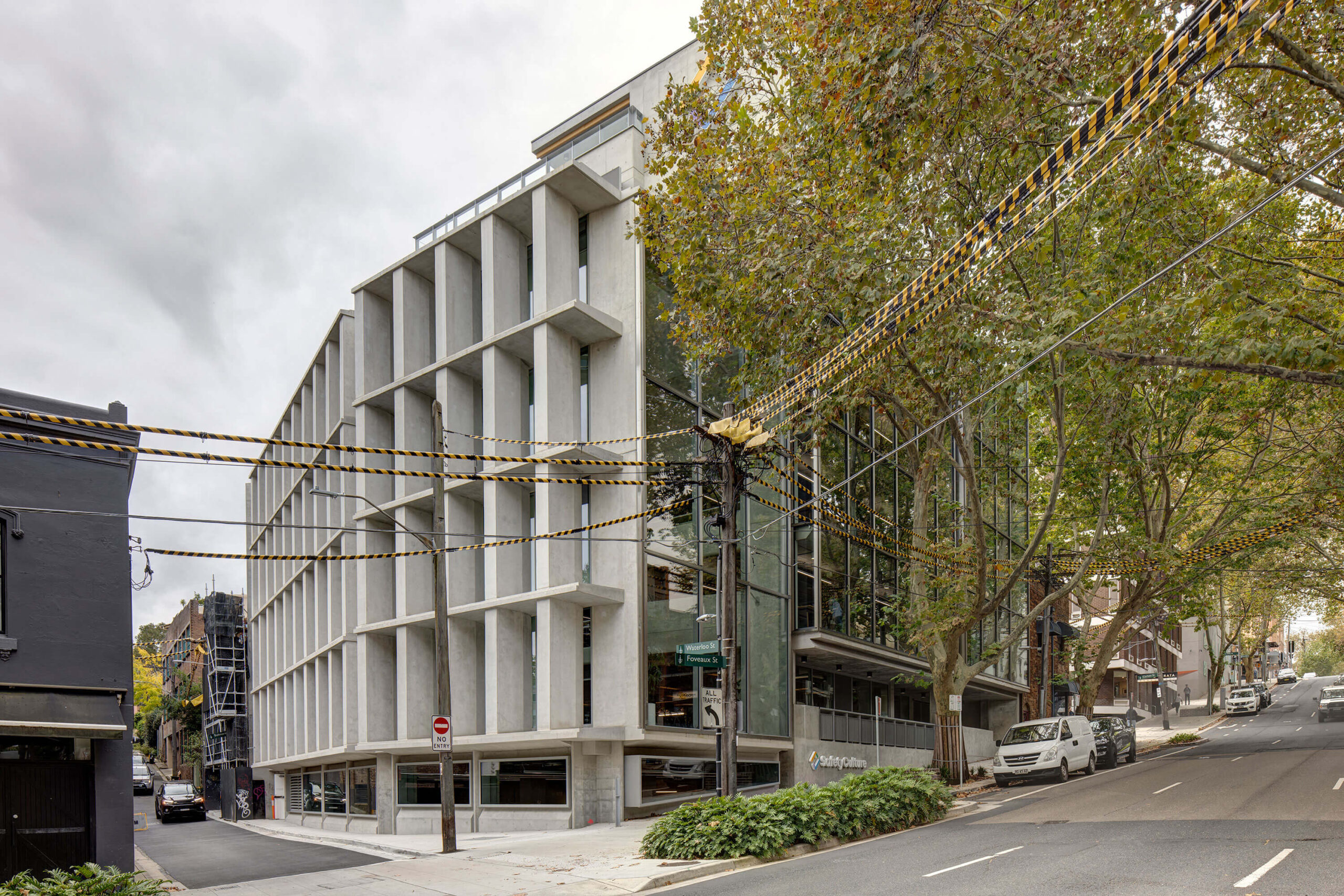
The Foveaux Street project preserves a 1960s and 1970s sewing factory, stripping the existing six level concrete and brick structure down to its basic elements. The renovated building maintains low floor to ceiling heights, enriched by a large west and south facing internal atrium incorporated into the eight level commercial expansion.
This space serves as a focal point, featuring a glass artwork by Janet Laurence and carefully crafted concrete brise soleil for controlled light. The communal atrium, shared with the city through a south facing window, enhances the office environment.
White lanterns augment natural light, creating a dynamic workspace with a relaxed engagement with the street. The project transforms a slated for demolition building into a contemporary, flexible workspace, fostering a connection between the internal and external environment for office workers, ensuring its utility for years to come.
A building which was earmarked for demolition is now one which is kept and renewed into a contemporary workspace.
Freer Farm Agricultural Centre of Excellence | Philp Lighton Architects

TasTAFE Agricultural Centre of Excellence prioritizes practical education, adaptability, and connection to land. It emphasizes flexibility to evolve alongside technology and teaching methods, integrating elements of the landscape to engage students and teachers in both classroom education and practical studies. The Centre’s contemporary form symbolizes progressive farming techniques, featuring a ‘cattle grid’ facade for privacy and solar control, and rammed earth walls, depicting the red hues of the northwest farming landscape.
The integration of artwork to enrich the space’s narrative and functionality, enhances the learning environment. Sustainability measures include natural light, passive solar heating, and thermal mass walls made of rammed red earth to minimize energy consumption and regulate indoor temperatures effectively.
Frida & Diego: Love & Revolution Exhibition | Grieve Gillett Architects
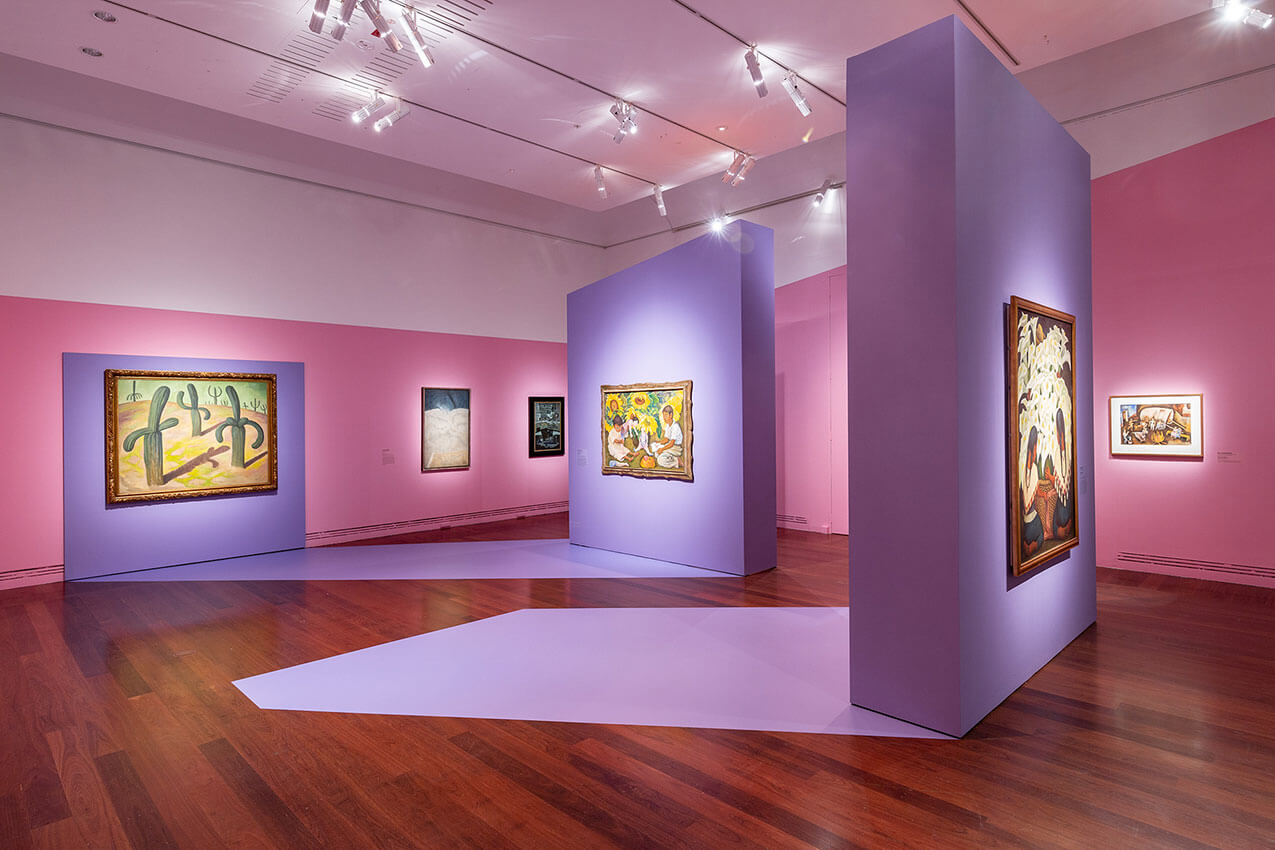
The design of the exhibition Frida & Diego: Love & Revolution reflects the passion of the artists and their love and their beliefs, as encapsulated by their artwork.
The design is unashamedly bold and stimulating and pays homage to Frida and Diego’s life in art and in the artistic community they constructed around themselves. As designers, our aim is to reflect the story of the artists by means of a carefully considered exhibition design and to enrich the connection between an artist’s works – in this instance, Frida and Diego and some of their contemporaries – their story, the viewer and the space.
With no Australian gallery owning works by either Frida Kahlo or Diego Rivera, this momentous exhibition offered Australian audiences access for the first time to such a comprehensive collection of paintings, photographs, clothing and illustrations by Frida, Diego and other Mexican modernists.
Fugazzi Basement | studio gram

“You know what a Fugazzi is? Fugazzi, it’s a fake. It’s a hazy, It’s a doozie, It’s fairy dust. It doesn’t exist. It never landed. It is in no matter. It’s not on the elemental chart. It’s not fucking real.”
Descending the stairs into the dimly-lit space, guests are transported to a rich underground lair, where the boundaries between reality and fantasy intertwine. As you take a seat at the bar, you’re consumed by a sense of intrigue, wondering what secrets this hidden basement may hold.
This is a place where reflective surfaces, sleek two-toned timber panelling, marble and geometric tile patterns are layered to evoke a sense of nostalgia that’s both decadent and indulgent, but it’s not real.
Fun House | ASA

Fun House seeks to push preconceptions of space per person on a small 117m2 urban site. The primary dwelling is constructed behind the existing cottage frontage and a secondary detached dwelling sits along the rear lane. Separation between the dwellings offers flexibility in household permutations, with a total of 6 people being able to reside on the site. The maximised central courtyard was important to provide both dwellings with access to light, ventilation and landscape outlooks.
Also serving as an intermediate space, each dwelling can passively interact with one another from across the courtyard. The incorporation of varying paint colours and material textures gives each room unique personalities within the efficient floor plan. Built to the Passive House Standard, using durable materials and high-performance detailing means the dwellings are futureproofed to withstand extreme weather events, whilst using very low operational energy.
Djerring Flemington Hub | Croxon Ramsay

The Djerring Flemington hub has been designed to foster social inclusion and sustainable design. Located at Debneys park, at the backdoor to the local public housing estate, the hub acts as an extension to these residents homes. Therefore, the connection to the public housing became the key focus of this design. Many community consultation sessions were run to understand the needs of the community. The building acts as a place of refuge for residents providing spaces to inhabit without the need to engage in scheduled program, as well as providing space for religious practices. The form took inspiration from the concept of shelter and the home. Using the portal frame as the foundation for the building as this is common in a domestic setting and feels approachable to the community. The form also aids in the passive design among other key features designed to achieve a 5star Green Star rating.