
TRACES
A photo essay by Benjamin Pitman
Through a series of photographs and reflections, Traces explores Ben’s evolving relationship with Adelaide, his hometown, and the enduring power of architecture to set things in motion long after the architect has stepped away
–
So there’s this thing that happens when surface water is exposed to the air. Trace minerals such as calcium and iron precipitate from the solution. Iron, in particular oxidises, producing rusty-brown deposits, while other minerals crystallise as thin layers. If the surface is vertical, gravity comes into play, drawing the water down. Over time, layer upon layer of mineral build-up forms organic shapes. This process is called mineral deposition. It’s the same principle that creates stalactites in caves or the colourful stains in this image.

Despite its looks, this isn’t a leaking pipe. It’s a drinking fountain. One in a series of five found in the entry hall of Peter Zumthor’s seminal bath house project – Therme, Vals – in a small mountain village in Switzerland. I first found myself in this hallway in 2006. I was a newly registered architect on a pilgrimage.
For me, and perhaps others of my generation, this building was my Parthenon. A work of such profound mastery that it was hard to believe it even existed at all. A work that transcended the idea of a community pool to something closer to a spiritual experience.

But on that day, no matter where I swam, lounged, or steamed, I couldn’t stop thinking about those drinking fountains. Clearly, this was an architect who knew his craft down to the molecular level. But why? And why there, in the entry hall, not even technically inside the building but within the threshold. Rusty red stains seemingly decaying the very wall that held back the mountain from which the meticulously laid stone was quarried.

Ten years passed, and having decided to retrace my steps to that same remote mountain village, I found myself in that hallway again, a little older, a little wiser. And this time it was clear. The stains had grown like living artworks. This was not a building showing decay, but a building, layer by layer, recording the passage of time.
And this became the most influential lesson I’ve ever had. Architecture isn’t finished when the drawing is. The true act of architecture isn’t what we design, but what we set in motion.
I think about this a lot; the power we hold when we design, and when we design well. Once something is set in motion, it no longer belongs entirely to us. Every decision we draw becomes the background for someone else’s life – a place where they fall in love, eat breakfast, wait for the bus.
That’s the quiet power of architecture. It keeps living long after we’ve moved on. A city is a great example of this. Like the bath house wall, it records use and change – layer by layer, every addition, every act of care or neglect leaves its mark. As architects and place-makers, we inherit traces from those before us, we add our layer, and then we hand it on. Sometimes that means building on what’s already there. Other times, it means having the courage to remove, to renew, or simply to hold space for what might come next.
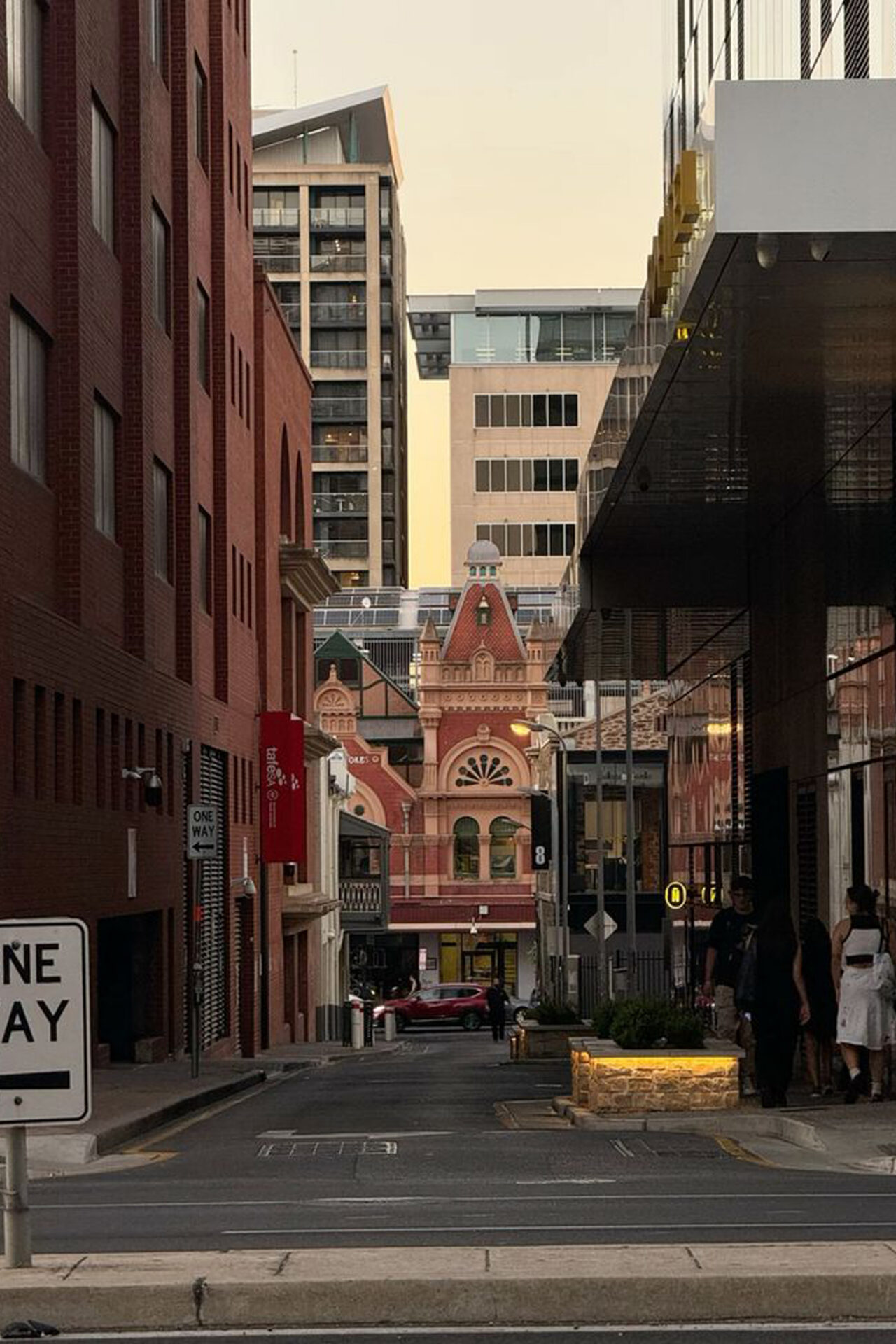
I often think about my home-town of Adelaide; those who came before, and what they set in motion. The trams that once stitched the suburbs together, replaced by diesel buses. The wide streets drawn for a population that never arrived. The decision to settle here, high on this plain, rather than at the port where the city was first intended. And before all of that, before survey and colonisation, the Kaurna people: the true beginning of this place, whose deep understanding of the land was shaped by its rhythms, its seasons, and its stories.
I’ve been back in this city for three years now. I left after graduation and spent two decades in Melbourne, carving out a career and contributing to that city’s progress. But I always remained loyal. I realised recently that I’ve had the same wallpaper image on my phone for the better part of a decade. It’s a photo I took of Adelaide’s Festival Theatre on New Year’s Eve. I suspect I was tragically deep in thought, pondering the complexity of its facade’s construction, while others were counting down to midnight.

To think this was Australia’s first multi-purpose performing arts complex, not imported from Scandinavia but imagined by a local firm that would later grow to reach across four continents. It’s easy to forget that this building wasn’t simply commissioned. It was willed into being by the people of Adelaide, who raised the equivalent of one million dollars to meet its target within a week. That’s not architecture funded by government, that’s architecture funded by belief. And perhaps that’s the real reason it still stands as the emblem of our city.
Loyalty aside, I’ve also been quietly critical of my hometown. As a designer, I’ve envied the energy and progressive culture of other cities and struggled with Adelaide’s reputation on a national level – a conservative city, a boring city, a mocked city, a city to leave for brighter lights and opportunity. The forgotten city.
And maybe there’s a hint of truth in that, but it doesn’t tell the whole story. Because it’s really a beautiful city: a garden city, a festival-rich city. And if you’ve ever lived in a very big city, you’ll appreciate that it’s a traffic-free city, a safe city – a most liveable city.
But the secret’s out, and change is afoot. The spotlight is shifting Adelaide’s way. Since being back, I’ve found cranes on the skyline, precincts being reimagined, rent and house prices soaring, new suburbs materialising, and universities merging. There is energy and interest flowing in from the east coast and beyond. The city is shifting in its seat, and deals are being done.

So there’s this thing that happens when we get together to share ideas and inspire each other. A vibrancy forms, a community grows, but most of all, a movement is set in motion.
For those beginning their careers or considering where their future might unfold and like me, you love architecture (because you really have to love it), it may have crossed your mind whether this town is for you. I can tell you there will always be brighter lights, but opportunity now lives here.
If you want to make your mark – stay. There is never a better place than a city on the verge of change. Never a better place craving new ideas and fresh perspectives. Be prepared to work hard. Take risks. Challenge that which has come before you. Be informed. Be inventive. Be brave enough to disrupt the ordinary with purpose. We need the best minds right now.
Like the mineral stains on Zumthor’s wall, what we create will record us. It will speak of how we thought, what we valued, and who we were.
The question is – what kind of traces will we leave?
Traces is based on a talk delivered at Adelaide’s inaugural 3 Over / 4 Under event in November 2025, presented by EmAGN (Emerging Architects and Graduates Network) on the theme of Disruption. The original presentation combined spoken reflection with curated imagery. This photo essay presents the work in an adapted written form.
Benjamin Pitman is an Associate Director at Studio Nine Architects and co-founder of PARABOLICA.
Photo 1 – Therme Vals drinking fountain by Fernando Guerra
Photo 2 – Therme Vals by Fernando Guerra
Photo 3 – Therme Vals by Fernando Guerra
Photo 4 – Rosina Street, Adelaide CBD by Jordan Chamary
Photo 5 – Adelaide Festival Theatre by Benjamin Pitman
Photo 6 – Adelaide skyline by Benjamin Pitman