
The Victorian Chapter of the Australian Institute of Architects hosted the International Women’s Day Breakfast, marking an afternoon of insightful discussion on advancing women’s agency and empowerment within today’s architectural profession.
REVIEW BY JULIA XU
EDITED BY MALISA BENJAMINS AND MARIKA NEUSTUPNY
As we approach 2025 and reflect on the thirtieth year anniversary of the Beijing Declaration and Platform for Action, a visionary plan, which identified twelve key areas of action to improve equal rights for all women and girls, the call for gender equity still remains as relevant as ever. Despite decades of progress, gender disparities persist across unpaid care work, career progression, and leadership representation across many different areas of society. Within the architectural profession this is evident from the research and data collected by Parlour from the Census and the Workplace Gender Equality Agency Australia (WGEA) data and in the AIA Diversity and Inclusion in the Architecture Profession Report (2023).
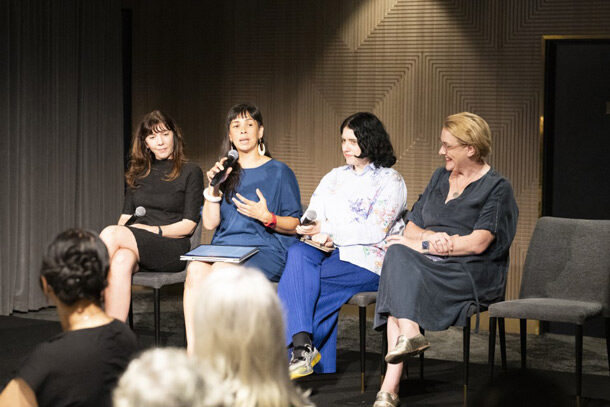
The 2025 International Women’s Day breakfast hosted by the Victorian Chapter of the Australian Institute of Architects in March this year, explored these challenges with robust discussion around how to progress gender equality within the profession through leadership opportunities and systematic change. A compelling panel of architects, policymakers and gender equity advocates, including policy adviser and researcher Emma Dawson, writer and activist Eleanor Jackson, senior architect Lucinda Arundel, director of research-based practice Amelia Borg and Victorian Government architect Jill Garner, brought rich perspectives and bold ideas to the forefront of this year’s conversation on addressing gender equality within architecture.
Through my work at the Robin Boyd Foundation, we often reflect on how the architecture and design professions can better represent the communities we serve—particularly by amplifying the underrepresented voices of women. Curating programmes that centre diverse voices is not just a professional priority, but a personal mission shaped by my own experiences navigating a sector that still struggles to hear us. Attending this year’s RAIA Victorian Chapter International Women’s Day event focused on advocating for gender equality and women in architecture, felt both affirming and galvanising. It reminded me that while progress is undeniable, the path to equity remains complex and unfinished.
This thought-provoking panel brought together a diverse group of voices who each offered a distinct perspective on how to drive systemic change in the architecture profession and beyond. Emma Dawson highlighted the critical role of public policy in shaping more equitable structures, drawing on decades of policy reform and the power of quotas to shift representation. Eleanor shared how community-centred approaches and radical engagement can redefine leadership and workplace culture, advocating for equity not just as an ideal, but as a lived reality embedded in care and connection. Amelia brought insight from practice grounded in social research, reflecting on leadership in small studios and the importance of metrics, flexibility, and emerging models that support balance and inclusion.
Lucinda challenged traditional hierarchies, calling for structural reform backed by data, evidence, and the courage to embrace alternative models. Together, their contributions painted a rich and tangible picture of what meaningful, multi-dimensional progress within the architectural profession could look like.
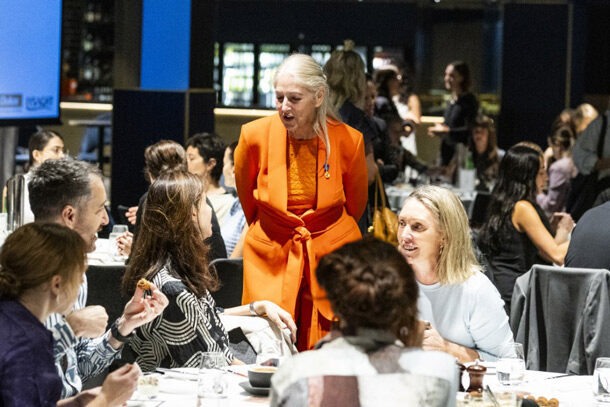
As convenor, Victorian Government Architect Jill Garner AM opened with a structural lens, reflecting on the architectural profession’s deeply entrenched work model — one that has remained largely unchanged for over a century. She began by referencing Deborah White’s 1975 article in Meanjin, a powerful reminder of how conversations around gender equity in architecture have been circulating for decades, yet with minimal structural shift. This set the tone for a discussion that interrogated not only what has changed, but what has stubbornly remained the same. Jill posed straightforward yet still-unanswered questions around pay equity, diversity at all levels, decision-making, and selection processes urging the profession to confront these issues head-on. Jill challenged the industry to view architects not through the lens of gender but of capability, quoting Danish architect Dorte Mandrup, who notably stated ‘I am not a female architect. I am an architect’, while also acknowledging that equitable systems must be created to make that vision possible.
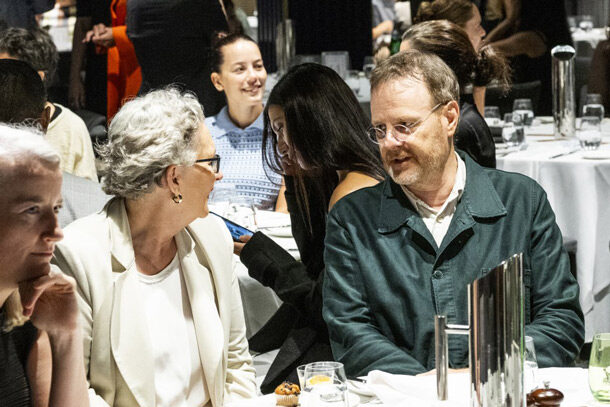
Senior Architect Lucinda Arundel brought insight into the often invisible barriers of unconscious bias, drawing from her own experience of entering the architecture profession after having studied various other disciplines. Her ability to articulate ideas and lead decisively saw an accelerated rise to leadership positions—yet the same ‘non-feminine traits’ that contributed to her success were at times negatively perceived. She spoke of how leaders often promote those who resemble themselves, a dynamic rooted in unconscious bias and a key contributor to the persistent lack of diversity in leadership. This is particularly concerning in light of findings from the RAIA’s Diversity and Inclusion Report (2023), which revealed that 70% of male respondents do not believe gender equality is an issue—highlighting a depth of cultural resistance or ignorance to change. Lucinda advocated for the use of quotas and positive discrimination as necessary levers to disrupt entrenched patterns, particularly within procurement and government tender processes. Her call to radically rethink how the system operates is both a critique of the status quo and a roadmap for structural change that can help build a more equitable profession.
Emma Dawson, Executive Director of Per Capita, brought a broader policy perspective, reminding us that quotas do work and to look to progressive professions outside our own —citing the Australian Labor Party’s gender quotas introduced 30 years ago, which reshaped the party’s internal structures and public representation. Emma underscored the importance of role modelling at home and at work, breaking down gender binaries, and empowering men to vocalise and share responsibility for cultural change.
She noted women in Australia tend to fall behind on the career ladder as workplace flexibility remains less progressive than in other countries. This can be addressed through public policy and changing norms, such as shorter working weeks and remote work options, which while requiring a shift in cultural norms have been proven to work in the post Covid workplace. Support and affirmative action from men in leadership roles is a key step towards achieving gender equity in the workplace. This is evident through established and recognised initiatives such as Male Champions of Change, which supports gender equality and acknowledges that affirmative action and advocacy are necessary for change.
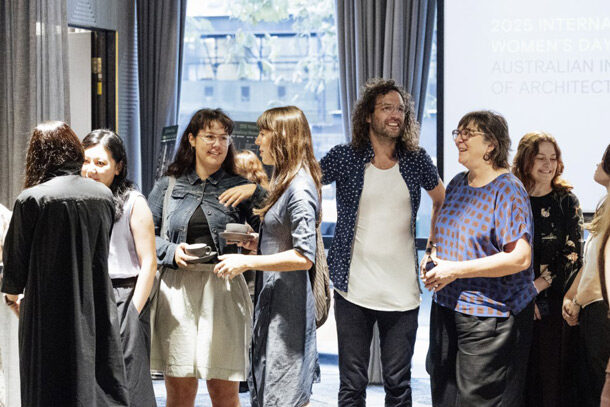
Amelia Borg, Director at Sibling Architecture, reflected on leadership from her perspective as co-founding member and co-director of the small practice. She described how Sibling developed out of a desire to create a collaborative studio and workplace culture with a more non-hierarchical structure, setting it apart from the traditional setup of more established architecture firms. She highlighted the importance of policy and measurable initiatives that create meaningful change at all levels of leadership. Amelia’s emphasis on embedding balance into leadership metrics echoed a broader call to normalise part-time and flexible roles—particularly within leadership itself. Her advocacy for embracing feedback at all levels speaks to a maturing conversation around inclusion and shared responsibility.
Amelia also noted that architects are often ‘emerging’ during the most fertile years of their lives, given that professional and career development often requires significant experience—delaying progression compared to other professions. For many women, this period overlaps with increased focus on family and
caring responsibilities, which can compete with traditional pathways to professional growth. A reminder that the expectation to leap from emerging to established practitioner status can be jarring in this context, and that the prospect of creating work-life balance is important for a sustainable, gender equal profession.
Writer and equity advocate Eleanor Jackson launched the discussion with a sharp examination of leadership and the entrenched norms that continue to shape it. She spoke to the pressures many women face when navigating leadership pathways—particularly the need to “act like a man” to be recognised or accepted. With career progression often peaking during childbearing years, the expectation of being constantly present—early, late, and always available—remains incompatible with care responsibilities. Eleanor questioned the tribal status quo of workplace culture and the growing backlash against diversity and equity initiatives. She urged a reimagining of leadership that embraces feminised thinking, redefines what effective leadership looks like, and breaks away from outdated metrics of success. Her support for quotas—especially in the public sector—and her call to teach architectural history from a non-heteronormative, non-Western male perspective underscored the need for a systemic worldview shift.
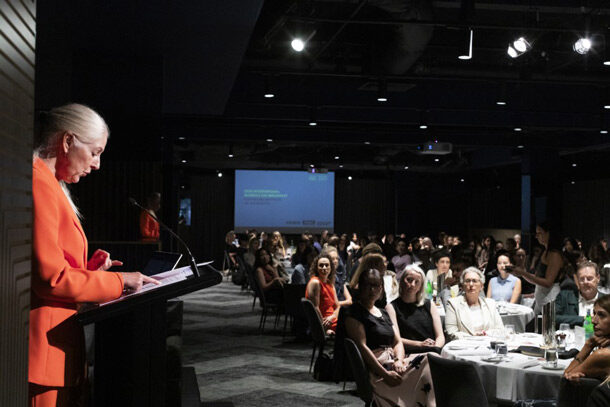
Lucinda and Eleanor further explored alternative models of practice, highlighting the profession’s ongoing resistance to change—even in the wake of Covid’s disruption to traditional systems. Lucinda questioned why part-time leadership roles remain the exception rather than the norm, emphasising the need to extend flexible work options to all—not only to mothers. Eleanor spoke to the critical role of care labour and its value within healthy, resilient communities and economies. Her passionate advocacy for a four-day working week aligned with global momentum and offered a tangible, hopeful model for redistributing unpaid domestic responsibilities.
Each speaker brought compelling insights into how rethinking workplace structures—through flexibility, balance, and care—can benefit women, enrich practice culture, and create more inclusive, sustainable ways of working. Together, their contributions invited the audience not only to reflect, but to imagine and enact new possibilities for leadership and professional life. Referencing Helen Pankhurst, Jill urged participants to contribute to change by role modelling, teaching, and demonstrating equity in action. It is through these everyday decisions that we build momentum—towards a more inclusive, sustainable, and equal profession. True equality requires more than allyship—it demands genuine partnership and shared responsibility.
Women should not have to choose between their personal ambitions and societal expectations. It is time to transform promises into meaningful progress, addressing systemic inequalities and ensuring that women’s contributions—both paid and unpaid—are valued and supported. It is important to recognize equality is not just about women, it is also about beneficial change across the profession and equality for our male and non-binary counterparts. The session closed with an empowered summary from Jill and a powerful call to shift culture through democratic acts of resistance—echoing the spirit of the Beijing Declaration and reminding us that turning commitments into action remains both our challenge and our responsibility.
Click Here for the IWD 2024 Event Review by Nikita Bhopti